

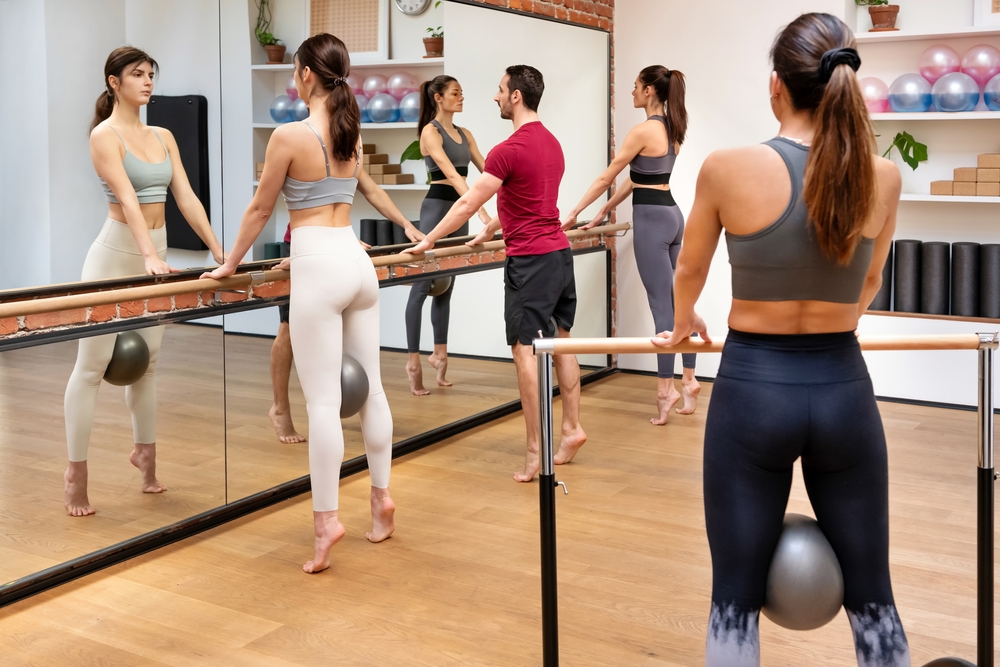
Barre or barre workouts are one of the most popular and unusual fitness trends of recent years - and they've been around since 1959!
The mix of ballet, Pilates and yoga in barre exercise strengthens and tones the body, stretches it and works towards an elegant, confident posture. A workout that demands precision and ambition without falling into a higher, faster, further trap.
ISPO.com takes a closer look at the unusual barre workout and its benefits!
Barre workout - what you need to know
- What is a barre workout?
- How does a barre workout work?
- What does an hour barre workout look like?
- Advantages of the barre workout
- Who is the barre workout particularly suitable for?
- Where can I do a barre workout?
Sore muscles - when can I train again?
Where did the idea of the barre workout come from?
In London in the 1950s, the German-born ballerina Lotte Berk developed a new style of training after an injury, which combined the dedication and high performance of ballet with the gentle movements of yoga. In 1959, she began teaching under the name Barre, based on the name of the ballet barre that was used extensively in her classes.
She not only made sure that the exercises reflected the natural elegance of ballet, but also incorporated movements from physiotherapy that specifically developed the musculoskeletal system.
Her students included some of the world's biggest stars, and the fitness trend slowly spread, especially in the USA. Since 2010, there has been a veritable flood of courses after the movie Black Swan Ballet whetted the appetite of a young, sports-loving audience.
How does the barre workout work?
Barre is usually practiced in yoga clothing. Barefoot or in socks with rubber studs for better grip allow the feet to move freely and stand securely. This makes barre unique among workouts that usually ignore the feet instead of including them in the stretches and poses.
For most exercises, you will need a ballet barre or, as an alternative, a chair back. Otherwise, there is a range of suitable equipment such as therabands, light weights or balls from rhythmic gymnastics.
Something very special is the ballet music, which usually plays in the background and is very different from the techno sounds of high-performance training and the calming, swaying sounds of Pilates.
These are the best fitness apps
What does an hour of barre workout look like?
Warm-up exercises and ballet movements
Barre also begins with warm-up exercises, but these are an integral part of the ballet movements. This makes the workout exceptional because, as in ballet, you work your way through a routine set of movements and steps that loosen various joints, engage muscles and increase your concentration.
Targeted muscle training through dance steps
You complete various exercises and dance steps, each of which trains specific muscles. Your upper body remains calm and relaxed while your lower body does the work. This not only improves your posture, but also your balance!
Routines for relaxation and concentration
The fact that the routines are very fixed helps most people to relax. Your mind can concentrate fully on your body awareness and the correct execution of the movements, as your legs and arms already know the sequence. This lowers your stress levels and allows you to slip into a calm, focused state.
Ballet exercises to shape the muscles
You will get to know and love many typical ballet steps in barre, such as pliés, relevés and pas de bourrées. They shape your thighs, calves and glutes in particular and are the elegant, refined form of the classic abs, legs and bums program.
Posture training to avoid discomfort
One of the most important aspects of the barre workout is good posture training. During the class, a lot of emphasis is placed on a posture with body tension without tension. This also helps to prevent back or neck problems and helps to develop a sensitive awareness of your own body.
Additional aids and finishing with stretching
In addition to the barre, other objects can also be used, such as weights, small balls or walls for support. The class always ends with extensive stretching and a cool-down.
Advantages of the barre workout
Easy to learn through repetition
A barre workout is surprisingly quick and easy to learn as the exercises are repeated continuously. Many people hesitate at first because they think the ballet aspect is very demanding, but the workout actually involves mainly basic movements as taught in ballet schools at every level.
Promoting health through physiotherapy exercises
The undeniable advantage over many other dance-oriented or yoga-inspired workouts lies in the implementation of physiotherapy exercises that emphasize and promote the health aspect. Barre training is therefore also extremely suitable for people with physical complaints of any kind.
Aesthetic benefits: Radiance, elegance and self-confidence
Many people particularly appreciate the aesthetic aspect, which shifts the focus away from pure performance. Barre sport doesn't just want to challenge your body and keep it healthy, it also gives you charisma, elegance and self-confidence, which also strengthens your inner self.
Increasing mobility and flexibility
Barre also has a positive effect on your mobility and flexibility. All the influences from Pilates, yoga and ballet stretch you and loosen your joints and muscles. This also benefits older people, people with chronic illnesses and obese people!
Variety and creativity through individual movement variations
And although barre is based on fixed routines and movement sequences, it offers plenty of variety and the freedom to create new combinations.
Neuroathletic training and neuroathletic exercises: Fitness for the brain
Who is the Barre workout particularly suitable for?
Barre for all ages and fitness levels
Barre is one of the few workouts that is truly suitable for all ages, fitness levels and physical limitations. This is because the movements can usually be easily modified and therefore individualized, but are always gentle on the joints and muscles and solely determined by your own body weight. This means that there is hardly any risk of injury and very good control if performed properly.
Getting back into exercise after an injury or longer break
For many people, it is therefore an attractive way to return to sport after an injury or a long period without exercise. It reliably rebuilds the body and fitness and gives you back a strong body feeling.
Anaerobic training: how to burn fat properly
Barre for pregnant women: gentle training during pregnancy
Pregnant women are also often recommended to switch from other, usually more intensive training programs to Barre. This is because the aspect of balance and reflecting a feeling for one's own body is worth its weight in gold during the major changes that accompany pregnancy. It also puts little strain on the upper body, so exercises are rarely out of the question due to the bulging belly, making pregnant women feel less frustrated by their belly. But as in any case, it is important to talk to a doctor in advance about what limits you should set and what effort is reasonable.
For all those who strive for an elegant and athletic posture
Barre has also become fashionable for those who don't just want to train their muscles but admire the athletic body and self-confident posture of ballet dancers. Barre always trains this, which not only makes you look more elegant, but also reduces the discomfort caused by poor posture in everyday life.
Barre for targeted muscle training without exhaustion
Barre is also an excellent training method for those who attach little importance to the dance aspect and are looking for a program that targets a variety of muscles and burns calories without always aiming for absolute exhaustion. This is because it combines strength, stretching and endurance training in equal measure without appearing overly demanding at first glance.
You can learn these skills in yoga for everyday life
Where can I train Barre?
In the USA, barre is experiencing a boom and has been on the course schedule in more and more fitness studios since 2010. In Germany, it is still largely unknown, but is increasingly being offered as an additional class in ballet schools. This is practical because the local teachers have often been dancers themselves and therefore have a lot of experience both with ballet and with special physiotherapeutic exercises.
There are also a number of online courses available on the internet, which you can use to create your own ballet studio in your living room using the back of a chair!
Back training: you can train your back effectively with these tips