


Sportswomen don't want fashionable clothes. Really? More and more resourceful women are now realizing that this stereotypical view is no longer valid and are founding female sports brands. They are focusing on empowerment through fashion, in the knowledge that today's adventurous women want to be both strong and fashionable. Whether it's Astrid Wild from Sweden, Jeanne Baret from Italy or Girlfriend Collective from the USA - these brands, often inspired by female makers, defy the standards of the fashion industry and focus on sustainability in many facets.
Astrid Wild is one of the few female brands in the industry. After five years of successfully establishing itself among female outdoor consumers in Scandinavia, the Swedish brand is now launching its online store for Germany.
"Our design and product team is made up of 100 percent women, so everyone who works with us really understands what that means," says co-founder Maria Paulsson Rönnbäck. As a result, the Swedish company currently has the widest range of sizes for women in Europe.
By women for women is also the motto of the Norwegian company Kari Traa. "Every garment is designed with a precise understanding of the female body. We emphasize functional design that does not sacrifice style, and ensure that our clothing enhances both the performance and self-confidence of the wearer. By focusing on the specific needs of women, we have set a new standard for fair, comfortable and beautiful outdoor clothing," says General Manager Georgina Kirby.
LaMunt saw the light of day in 2020. Even though the women's mountain sports brand is part of the Oberalp Group, the core team is made up entirely of women – in the spirit of a female brand that consistently focuses on female perspectives. During the development phase, initiator Ruth Oberrauch not only incorporated her own wishes and ideas into the new collection. In discussions with 25 women with an affinity for the mountains, but also with different backgrounds - from mountain fanatics to occasional offenders - pain points were discussed, i.e. problems that female athletes have had with clothing up to now: for example, the lower back area, which tends to be more sensitive in women, where there is often a pull if a jacket is too short or trousers are cut too low. Or a jacket that rides up or is too tight on the hips or has an elasticated waistband.
"We know exactly how the female body differs from the male body," emphasizes Rönnbäck from Sweden. For this reason, Astrid Wild offers pants in 42 sizes and three different leg lengths. There are also many different solutions to ensure an optimal fit, such as an elastic waistband and stretchy materials. "Among other things, we always show our pants in at least two different sizes in our online store so that our customers can get a feel for how the product will look on them." According to Rönnbäck, she and her co-founder have responded to the existing outdoor industry, which has a very narrow image of an outdoor person. "However, when we entered the market, we didn't have as wide a range of sizes as we do today. This is a result of interaction with our customers and the community. We really do everything we can to make sure our products fit most women's bodies. And that's one thing that I think really sets us apart."
The female brand Jeanne Baret - on the market since 2023 - also focuses on fit. According to Marketing Manager Alice Testi, the design approach focuses on the different shapes and sizes of women and counteracts the industry's tendency to design fashion primarily for a limited number of body types. The same applies to the Kari Traa brand: "The Kari Traa brand was born out of the ambition and desire to develop outdoor clothing that does optimal justice to the female figure and emphasizes it, rather than simply adapting men's models," explains General Manager Kirby. Through training and competing around the world, founder Kari Traa realized first-hand that traditional sports and outdoor clothing often overlooks the specific needs of women.
At Astrid Wild, every pair of trousers, every skirt, every shirt is given a woman's name: "We felt that it was a good opportunity to highlight really cool women that you might never have heard of," says the co-founder, explaining the idea of associating every product with a woman. Another advantage is that the community can be integrated into the naming process. "They are the ones who vote."
At Jeanne Baret, the garments are given the names of cities and islands: "It's more than just a naming convention; it's a way to connect our products with the spirit of discovery, culture and adventure that defines us." It is the legacy of the female brand's namesake - the first woman to sail around the world. "By naming our products after the cities and islands she visited on her travels, we are paying tribute to this spirit of discovery."
The up-and-coming female brands play on the theme of sustainability with many different facets - from ethical production to dual functionality and timelessness. "We wanted our garments to be versatile and able to be worn by women year after year. Muted colors offer this longevity and allow customers to invest in pieces that remain stylish through the seasons," says Jeanne Baret's marketing manager. Astrid Wild also made a conscious decision to use muted tones. Rönnbäck: "We strive to make clothes that our buyers can wear for years. It also makes it much easier to wear our products at work, for example. So we don't focus on any trendy colors."
According to Rönnbäck, locating the entire production in Europe was a very conscious decision. This applies to both the manufacture of the fabrics and the production of the pieces. "But it also means that production falls under EU legislation when it comes to working conditions, for example. And we can go there and visit the manufacturer. This is important for us, not only to have a good relationship, but also to ensure that the people who work there are doing well." Another advantage of producing in Europe is the ability to order smaller batches. "We have a more demand-driven product or production structure. Instead of only producing larger quantities twice a year, we basically produce all year round." As a result, there are no big sales at Astrid Wild because, according to Rönnbäck, there is no overproduction. "That's pretty unique in the fashion industry."
“We believe that those who don't waste are doing good,” reads the Girlfriend Collective website. Founded in 2016 in the US as a sustainable fashion brand for sportswear and casual wear, the company has quickly made a name for itself. The focus is on “ethical manufacturing” of products and recycled materials. “Old water bottles and fishing nets look better on you than they do cluttering up landfills and polluting the oceans”. To reduce fabric waste, Astrid Wild reuses leftover fabrics: for example, to make accessories like the “Matchy Minna” headband, produced from fabric left over from “Minna” jackets.
According to marketing manager Testi, the Italian female brand Jeanne Baret aims to “gradually use fabrics that have less impact on the environment. Currently, we use recyclable organic polyester cotton, natural fibers and sustainable padding”.
"We have taken a very unique path, especially with our baselayers and the unique Norwegian style," emphasizes General Manager Kirby. It is a constant challenge "to maintain this special place, as other brands have expanded their range of clothing for women over the years". For co-founder Rönnbäck, the biggest challenge was finding potential customers for the new female brand. As Astrid Wild only sells through its own online store, the first step was to raise awareness. "We spent a lot of time and energy creating great content for social media. We also worked a lot with really great influencers who wear our products."
Even though female brands such as Astrid Wild and Kari Traa (still) share the closet with established brands such as Icebreaker, Patagonia and Lululemon, the ladies behind the women-only brands are certain that there are key differences: "Kari Traa is not just a brand with a women's collection - we have been a brand focused on women from the beginning. It was founded by one of Norway's pioneering Olympic skiers who wanted to bring women and girls together so they could confidently be themselves and live happier, healthier and stronger lives. This ethos permeates everything we do. Every product we design is developed with this belief in mind, and this clear focus allows us to optimize our offerings in a way that broader brands can't."
At Astrid Wild, the long-term goal is to become the most popular and iconic outdoor brand for women worldwide. "In other words, to offer everything our customers need for their outdoor experience - at least in terms of clothing. Then we'll see what happens with the equipment," says boss Rönnbäck. The Swedish female brand's short-term goal is to become "an aspirational and inclusive outdoor clothing brand that is accessible to women in Europe".
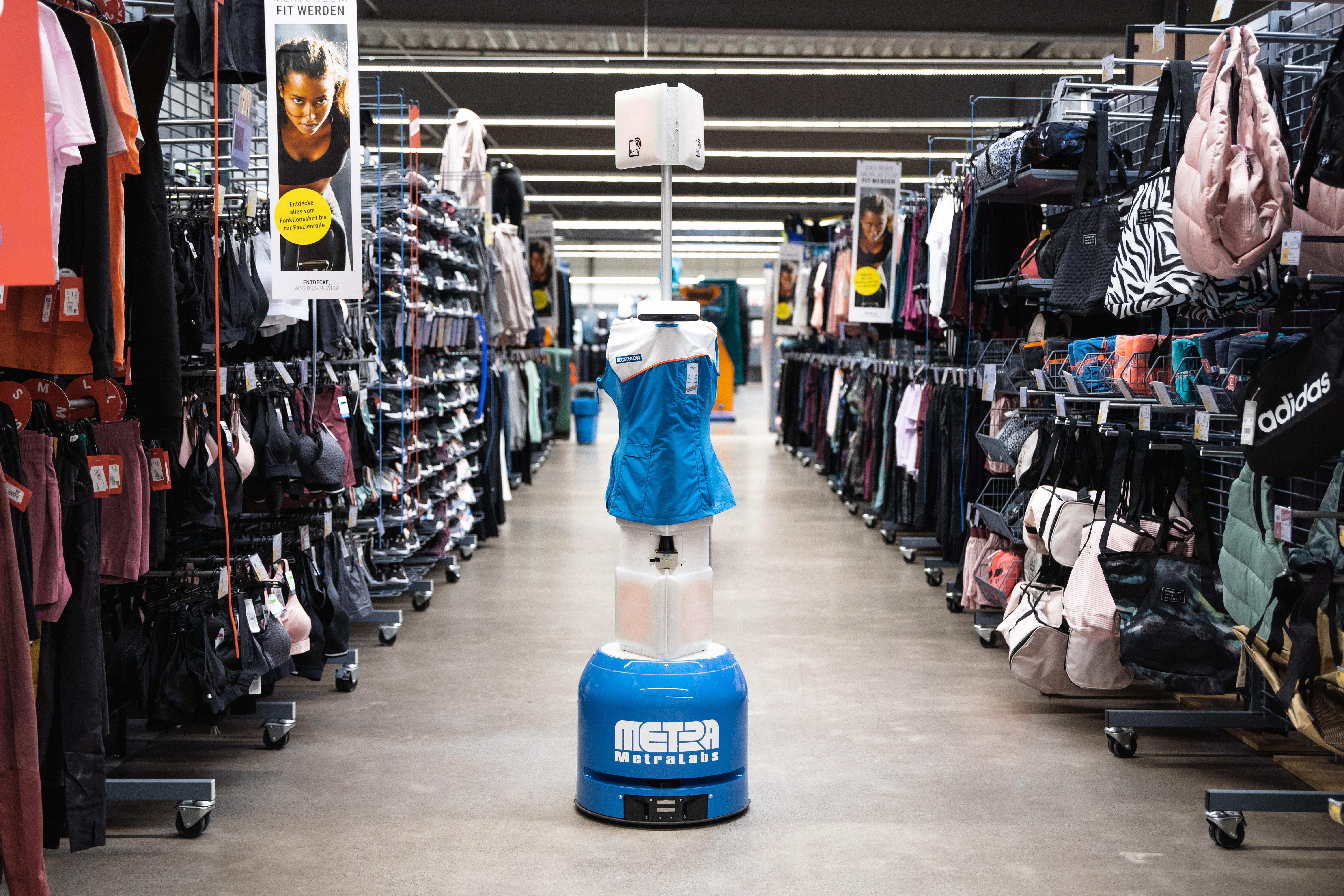
A robot helps with stocktaking, smart mirrors recommend suitable items in the fitting room and chatbots answer all our questions - the use of artificial intelligence can increase a retailer's appeal and boost sales. However, not all retailers have yet recognized the benefits of AI in retail stores. Nevertheless, the industry is waiting in the wings.
The door to the sports store opens and a robot greets us with a friendly "Hello" and the question "What are you looking for?". And then it accompanies us on our shopping trip. It suggests suitable products, guides us to the best deal or shows us on its integrated screen how a T-shirt looks on us without us having to try it on. Dreams of the future? Not for much longer!
Robots with learning capabilities are already helping retailers with important tasks, such as keeping the right products in stock in sufficient quantities. But how can stock be managed more efficiently? How can sales data be analyzed more quickly - combined with (seasonal) demand forecasting?
The first "Tory" started work in April 2021 at Decathlon in Stockport, UK. Since 2022, the RFID robot has also been helping with stocktaking in German Decathlon stores. The RFID robot automatically travels through the aisles of the store outside of opening hours and scans the RFID labels on the products. In Ludwigshafen, it takes around 3.5 hours to cover an area of 4,300 square meters and 93,000 products - a sporting achievement! According to press spokeswoman Nora Lühne, Decathlon already has 64 automated employees working at the beginning of 2024.
"Our most important indicator for the success of the project is the availability of our products. Since the start of the test, this has been five percent higher in the Ludwigshafen store than in comparable Decathlon stores," says Sven Neuheisel, project manager for the RFID robot at Decathlon Germany. Another advantage: the teammates save time and can focus on providing advice.
The inventory robot was developed by MetraLabs, a German company that specializes in service robots for the retail sector. Tory" is already driving through stores in Australia and New Zealand. In Kmart supermarkets, it checks stock levels and reports gaps on the shelves. And perhaps the rolling helper will soon have another job: "Tory" can be equipped with a multimodal user interface with voice and touch input. And then customers can ask him where to find a particular product or department. The music of the future can already be heard.
In the office, smart assistants can already sort our emails according to priority, suggest answers, summarize extensive documents, answer calls or translate speech in real time. In eCommerce, AI supports visual product searches and offers personalized buying advice. There are virtual fitting rooms and communication via chatbot for FAQs. And in bricks-and-mortar retail? It is catching up: The proportion of German retail companies using AI in individual areas or across companies rose from 7.5 percent (2022) to 23.5 percent in 2023. This is the result of a study of the German Retail Association (HDE) in cooperation with Safaric Consulting and the University of Münster.
"We're at a stage where technology is getting better and cheaper and the case for automation in some of these areas is just becoming much more compelling," says UK McKinsey consultant Anita Balchandani (Source: World Economic Forum/Reuters). Looking at the fashion industry, McKinsey expects fashion companies to double their investment in technology from 1.6 to 1.8 percent of their turnover in 2021 to 3 to 3.5 percent in 2030.
Other examples cited by Reuters include the British online grocery pioneer Ocado, which sells its automated warehouses and lightweight robots to retailers in the United States, Europe and Asia. The US chain Sam's Club, which belongs to Walmart, has almost 600 robots cleaning the floors of its stores.
The German Federal Ministry for Economic Affairs and Climate Change sees potential applications for AI in four areas: head office, logistics and transportation, stores and customer experience. However, the current AI use cases are heavily concentrated in the "head office" area: the retail companies surveyed by HDE state that AI is used in particular for document processing in accounting (6.6%), general sales forecasts (5.6%), checking supplier data (5.1%) and for personnel requirements and workforce planning (4.6%).
In the "store" sector, too, it is still the rather simple AI applications that are used, such as camera systems for theft protection at the POS (7.1%). Artificial intelligence could not only personalize marketing or tailor product ranges to customer flows, but also adjust the price of products in real time.
Improving the shopping experience and thus increasing sales - stationary sports retailers could play a pioneering role here, for example with a robot that helps with the product search in the store and provides individual advice. Then there are smart mirrors that combine virtual reality with traditional shopping by transforming shopping into a convenient and enjoyable experience. For example, the mirror shows rain trousers to match the rain jacket or recommends the latest water-repellent running shoes. This is made possible by sensors in the changing room that use RFID technology to recognize the item being tried on.
The ideas are there, as is the technology - but there is still often a lack of implementation. 8.9% of the companies surveyed by HDE cite a lack of support from (top) management as one of the reasons for a lack of AI deployment. The desire for more concrete use cases is at the top of the list (66.7 percent), followed by lower costs for operating AI (57.8 percent) and increased benefits from AI projects.
The conclusion of the HDE study: cost- and time-intensive AI use cases are still hardly represented in retail companies, although both smaller and larger companies took part in the study. Companies may initially focus on using AI in areas where visible results can be achieved quickly in order to justify their investments. Another reason could be budget or resource constraints.
"Shopping experiences are increasingly taking place digitally - does bricks-and-mortar retail still have a future? We think so, absolutely!" says the website of "Knowledge4Retail". This consortium of 13 companies from the fields of retail, AI algorithms, platform economics and IT integration is building an AI data platform that connects the digital world with bricks-and-mortar retail - and it's all open source.
As part of the project, four prototype applications were designed and implemented based on the developed data model. These prototypes include intelligent intralogistics, strategic retail marketing to establish customer-specific stores, service robotics to support store employees and the Internet of Things connection of an intelligent refrigerator. "The motivation for the project is the fact that little data is available about the movement of products or the customer's interaction with a product in a store. However, the availability of such data would enable new services, for example the optimization of store layouts, the support of store employees and an improved shopping experience for customers," says Tim Schopf from the Technical University of Munich. He presented the project at the "International Conference on Artificial Intelligence for Industries" in California in 2022.
Schopf concludes: "In order to close the gap between physical stores and online stores, the industry must make an effort to connect the digital world with brick-and-mortar retail. However, it is not enough to just have individual digitalization solutions; a holistic concept for the entire industry is required. To achieve this goal, an AI platform for brick-and-mortar retail is needed that enables the industry to develop data-driven applications."

In 2023, between 150 and 200 billion items of clothing were produced worldwide - more than enough to clothe the next six generations. At the same time, more than 92 million tons of textile waste will be produced. A contradiction that shows: The fashion industry needs to rethink. One solution that benefits both the environment and companies is repair services. The United Repair Center (URC) is a pioneer in this field. At ISPO Munich, we spoke to founder Thami Schweichler about what repairs can mean for the industry.
Every second, a truckload of clothing ends up as waste. But the real burden is borne by people in countries such as Ghana, where around 10 million items of clothing end up as waste every week. Many earn their living by reselling these clothes - often under difficult conditions and with physical consequences. They carry these clothes on their heads to markets, often with loads of up to 50 kilograms.
Sustainability therefore not only affects materials and production processes, but also the people along the entire supply chain. Sustainable change begins with a change of perspective: who produces, sells and disposes of our clothing - and what responsibility do we bear as an industry?
For a long time, the textile industry followed a linear model: clothing was produced, sold and finally disposed of. But this system is coming under increasing pressure. A circular economy in which clothing is used for longer and recycled is becoming increasingly important. Repairs play a central role in this - they extend the lifespan of textiles and help to save valuable resources.
Three factors in particular are crucial for this change
More conscious consumers
Gen Z in particular is changing its buying habits and showing a growing interest in sustainable fashion. According to McKinsey & Co (2021), 75% of millennials also prefer brands that are committed to sustainability.

Sportswear is one of the most important fashion trends of the last decades. Hardly any other area has influenced the way people dress as much as sports. And the journey is far from over! With the concepts Zeitgeist by ISPO Edition and ISPO 520M by Highsnobiety, ISPO Munich showed inspiring examples and presented new ideas how to develop your business.
Sports and fashion have long been a dream team. Both have been influencing each other for more than a century, learning from each other and becoming an almost inexhaustible source of innovation and new trends. The boundaries between the two are constantly shifting, for consumers as well as for collections and retail. Last December, ISPO Munich once again provided its visitors with many new ideas and inspiring insights into the various opportunities and possibilities that this fusion offers brands and retailers.
From athleisure to gorpcore, tenniscore, balletcore and the cutting-edge blokecore, fashion loves these eye-catching, sports-inspired looks that quickly spread via social media. Blokecore, with its soccer-inspired outfits, has made it from viral social media trend to the top fashion rankings by 2024, the year of the European Championship. But sports-inspired looks in fashion are much more than a short-term fad: "Interest in active lifestyles is on the rise, and this also means that the functionality of fashion is becoming more important," said Enrico Pizzolato, shoe designer and product manager at Italian shoe manufacturer Dolomite, during a panel discussion at ISPO 520M by Highsnobiety. This means that the target group for sports collections is growing and the demands are changing. "Sports and outdoor brands have to find a balance between style and function.
The fusion of sport and fashion also makes sense from a sustainability perspective: "Clothing has to be versatile," says Miki West, founder of yoga label Studio K, which presented itself for the first time at the fair in the Zeitgeist Area. The designer pays attention to sustainable materials in her collections and moves effortlessly between streetwear and yoga wear. A similar design concept is followed by US yoga label Fabletics, which also made its debut at ISPO Munich. "Our motto has always been 'From Gym to Fashion'," says Daniel Klarkowski, VP Brand Marketing Fabletics Europe. Fabletics originated in California and is inextricably linked to the rapid rise of the athleisure trend about a decade ago. "At first I couldn't imagine leggings being worn everywhere in Europe, but once I saw the trend in California, it didn't take long for the look to be everywhere.
Thanks to athleisure, yoga clothing has seen strong growth in recent years, with brands such as Fabletics and Lululemon, as well as Nike and Adidas. According to a recent report by market research firm Technavio, the global yoga clothing market is expected to grow by a further 21 billion US dollars (around 20 billion euros) between 2025 and 2029. With a projected annual growth rate of 7.7 percent, the sector is benefiting from the increasing demand for high-performance, technology-based clothing, according to the study.
However, the move from the sports industry towards fashion and the development of more fashionable collections is also a threat to brands that have grown through functionality and a focus on their core target group. "It is important for a brand to stay true to what it is, otherwise it can easily lose credibility with its core audience," says Jeroen Meijer, senior marketing manager at Keen. "We have to accept that more and more people are interested in outdoor activities today, and that this creates a new dynamic." He is alluding to the fact that the gorpcore trend of recent years has created a new generation of customers who use and show off outdoor products outside of traditional environments, and who also have different demands. In retrospect, this balancing act has not always served brands well. "The fusion of fashion and outdoor is here to stay," is Meijer nevertheless convinced, "and brands need to respond."
Italian outdoor footwear brand Dolomite is more open to the idea, perhaps because design is so important in Italy. "People know who Dolomite is and what Dolomite stands for, which is functionality. That's why we have the freedom to try something new without losing our credibility," says Dolomite's Enrico Pizzolato.
Collaborations between strong fashion and sports brands are therefore an increasingly popular solution to minimize the risk of losing credibility. "In the end, it's a good deal for both sides. Both are able to reach new market segments that they couldn't reach before. And that's why I believe that collaborations between fashion and sports brands have a great future," says David Fischer, CEO and founder of Highsnobiety.
By the way, how well brands manage to strike a balance between sports and fashion could also be seen on the ISPO Award area. Here, various brands presented forward-looking solutions for combining fashion, sports, and sustainability.
It is interesting to note that Scandinavian brands in particular, with their typically minimalist aesthetics, are doing a good job of bridging the gap between sports and fashion. “In Scandinavia, people don't make such a big distinction between casual wear and work clothes,” says Eystein Wang, CEO of the outerwear label Scandinavian Edition, who presented his new collection at the Zeitgeist Area of ISPO Munich. His recipe for success is to enhance and modernize classic styles with functional elements. He sells exclusively in fashion retail stores. “It's hard for a brand to be distributed in both channels,” says Wang.
Yoga label Studio K, on the other hand, uses a variety of distribution channels, from its own monobrand stores in Bali to yoga studios and sustainable concept stores. "Sports collections like ours are definitely in demand in fashion stores," says Studio K's Miki West.
Fabletics has just launched a retail push in Europe - hence its presence at ISPO in Munich. The brand, which has been active in Europe since 2014, has previously only sold online through direct sales channels in Europe. Despite good growth, the EU market accounts for just under ten percent of total sales. Now, Fabletics is looking to connect with brick-and-mortar retailers and wholesalers to continue growing. "We see a lot of potential in working with retailers and wholesalers," says Daniel Klarkowski of Fabletics. The plan is for the new channels to account for 10 to 15 percent of sales in the future. With fashionable, sporty collections and brand ambassadors like Kate Hudson, Khloe Kardashian and actor Kevin Hart, Fabletics has a lot to offer retailers.
Ultimately, the convergence of sports and fashion also offers retailers new opportunities to position themselves and find an attractive niche. "I believe this convergence is happening on both sides," says Thomas Neuviale, founder of Fasunaa.com, an online store specializing in urban outdoor collections. "Fashion stores as well as sports and outdoor stores are becoming more open to fashionable outdoor brands."

Champions League record crowd: over 90,000 fans at the sold-out Camp Nou in Barcelona. European Championship final: more than 450 million interactions on social networks worldwide and the highest viewing figures on German television in 2022. Sure, it's about soccer. But it's about women's soccer! Something is happening – especially when it comes to women's sports in the media. The spotlight is growing, yet not equally distributed. How the relationship between women, media and sport is slowly changing, where things are moving forward and where there is still a need for action.
All insights at a glance:
It was a close call: About four weeks before the Women's World Cup kicks off on July 20, 2023, FIFA only reached an agreement with the media on TV coverage. Or was the poker game even a good sign for the increased value of women's sports in the media?
The fact is that for years, the numbers of women and girls involved in organized sports have been steadily increasing. At the 2024 Olympics in Paris, the aim is to achieve a 50:50 ratio between male and female participants. Now, one would have to assume that the ratio of women's sports in the media is also moving toward balanced coverage by now. Or?
But perhaps the addition of the word "women" is an indication that not all sports are the same. A look at studies from recent years reveals a clear picture internationally: In the U.S., the women's sport media coverage has increased by just 0.4% since the 1980s, to a share of 5.4% in 2019. In Austria, according to a study by exploristas a similar imbalance exists: 88% of sports coverage is devoted to athletes, while female athletes are significantly underrepresented at just 12%. At the same time, the proportion of women in individual sports is slightly higher at 23%, but in team sports it is lower at 2%. Other studies confirm that there is generally less coverage of women's sports, both in print and on television. Production is also of lower quality, with fewer resources, and women's achievements are portrayed as more trivial.
Of course, there are sports in which men and women have a similar presence, such as biathlon, where women receive roughly the same prize money. There is also coverage in athletics, alpine skiing or tennis, generally more in individual sports than in team sports. Depending on the country, coverage is often linked to outstanding individual female athletes. Examples for Germany are the tennis boom around Steffi Graf or the swimming hype around Franziska van Almsick. And the enthusiasm that the Williams sisters sparked for tennis went far beyond the USA. But there are still sports that are primarily considered male domains. These include Formula 1, ice hockey, cycling and motor sports. But soccer, basketball or American soccer also have a significantly higher proportion of men in the reporting. Typical women's sports, on the other hand, tend to be associated with grace, such as rhythmic gymnastics, gymnastics or figure skating.
The imbalance is related to the fact that a few male-heavy sports dominate media coverage. The "most beautiful side thing in the world" for fans is the main thing in the media: soccer, or more precisely, men's soccer. Other sports get much less airtime. The new popularity of women's soccer thus has a special significance: it combines the popularity of the sport with more attention for women in sports. The euphoria is felt throughout Europe, and at the same time strikes an economic and social nerve.
Taking another step back, one might ask why uneven distribution in the media is a problem in the first place. Whether it's the snippet of a feed post or the livestream on the screen, media shape how we perceive reality or explain it to ourselves. Especially regarding the visibility of women's sports in the media: When we see role models who resemble us, their achievements also seem more attainable to us. In this way, they act as an inspiration for young girls, who only then take up sports. So TV presence also contributes to the development of sports. Moreover, as far as sponsorship deals and competitive sports in many disciplines are concerned, visibility is currency. If you achieve enough reach, you can play the sport as a professional and make a living from it. In the age of social media, classic media no longer play the only role in this, but they still play a significant one.
"Women's sports is a hugely important area of development. It's the next big thing, both from a social and fan perspective. Interest in it is growing exponentially. It's not for nothing that the women's European Championship final in Germany was the most-watched TV event of 2022 and even had more TV viewers* than the men's national team matches during the World Cup in Qatar," says Haruka Gruber, Senior Vice President Media DACH at sports streaming channel DAZN.
This reflects a broader shift in women's sports media coverage, which is gaining momentum across platforms. That's one reason why DAZN followed other English-language models this year and launched DAZN Rise, a free channel that shows exclusively women's sports 24/7 - mainly matches and highlights from the Women's Champions League, European leagues and the LPGA Golf Tour, as well as handball and field hockey.
TV channel Sport1 is also concerned with the further development of women's sports in the media and is currently concentrating on football and volleyball. "For women's football, we have reoccupied the attractive Monday evening slot together with our partners. This new regular slot for the women's Bundesliga stands out in particular because there is no other match taking place in the German professional football leagues during this period," explains Annika Rody, Director Media Rights at Sport1. "Women's sport has a broad target group, including our Sport1 core target group of men aged 14 to 59, as well as women and young women who are specifically passionate about sport played by women."
The fact that media companies are now looking at sports other than men's soccer also has an economic background, of course. TV rights are becoming increasingly expensive. The sums that are being called up in soccer are hardly affordable for individual companies. Viewers would have to take out various subscriptions to watch all the games in a league. However, to justify investment in women's sports on that basis alone falls short of recent developments, because they also bring a breath of fresh air, freedom and exciting creative potential.
"Men's sports are mature, while women's sports are still growing. Everything that is still in the development phase has no mandatory rules, no elaborate play book. We can't make the mistake of applying the same rules of the game to women's sports as we do to men's sports. Our vision for women's sports on DAZN is to challenge the status quo of men's sports," says Haruka Gruber. This is also about equality and visibility, she adds.
The example of eSports shows that women can be a catalyst in sports for attracting new fans, including women, and increasing profits. In Asia, the largest market of eSports players and fans, the number of female gamers is growing rapidly, and more female eSports pros are generating more female viewers - and thus more sponsorship money. Li "Liooon" Xiao Meng from China pioneered this movement.
Sponsors are also recognizing the value, development potential and image boost that women's sports offer. In the USA, investors have recently poured a lot of money into women's soccer, tennis and basketball. Likewise, with the "Women's Sports Club", an initiative has been launched to facilitate the sale and purchase of rights in the women's sector and to achieve greater distribution of content. Because it is necessary to break a cycle: Brands worry about insufficient reach for greater spending, while media outlets complain about a lack of revenue from advertising partners to fund coverage.
What counts, however, is continuous coverage. "From my point of view, high-quality live broadcasts are also important," Rody explains the role of the media houses. "As many touch points as possible can strengthen the development of women's sports." She is convinced that this is the only way to transport "background info and stories worth telling" that go beyond individual highlights.
The international women's sports highlight of the Women's Soccer World Cup took place in July and August 2023. The TV rights package was awarded separately from the men's for the first time, but this did not go off without teething problems: FIFA demanded - surprise - a lot, and broadcasters were unwilling to pay the price. A similar problem as in sponsoring.
As a result, there was even talk of a World Cup blackout in several European countries before an agreement was reached a few weeks before the World Cup. In Great Britain and Germany, the broadcasting rights went to the public TV stations. The final of the Women's World Cup reached an impressive 14.8 million viewrs in Great Britain alone.
Let's look on the bright side: women's sports, at least soccer, are now the subject of tough negotiations for higher funding - which means more attention and, in most cases, progressive development. We'll see what remains after the 2023 World Cup. The next Women's World Cup will take place in Brazil in 2027.