


The industry is in a state of transformation. Consumer expectations are changing rapidly, driven by a growing awareness of sustainability and higher demands for the values that brands represent. At the same time, companies face the challenges of rising production costs, global uncertainties, and the need to integrate ecological responsibility into their business models. While simple solutions are rare, therein lies the opportunity for sustainable success. “A business that makes only money is a poor business,” Henry Ford once said—a message that couldn't be more relevant today.
There is often a complex trust relationship between retailers and brands, which can range from mutual benefit to disappointment. "Currently, many retailers often feel disadvantaged," says Katja Mendel, Retail Format Manager of the Outdoor Division at Sport 2000. She adds, “Brands have the opportunity to shape this dynamic constructively by building fair partnerships and optimizing processes so that both sides benefit.” Working together on equal terms can thus build long-term trust and foster stability and success in an increasingly competitive industry.
Additionally, consumer expectations regarding the shopping experience are shifting: the experiential aspect is becoming more important. Customers now expect far more than just a sales offer; they want a shopping experience that brings the values and world of the brand to life. Community engagement also plays a vital role in winning loyal customers and authentically conveying brand messages.
The solution to the industry’s challenges lies in a comprehensive approach: valuable partnerships, a value-driven corporate culture, and targeted investments in efficiency and innovation are more essential than ever. “Success in the sporting goods industry requires not only high-quality, sustainable products and a values-based corporate culture, but also smart investments in efficiency and innovation,” says Reiner Gerstner, Senior Brand & Marketing Adviser at Schöffel. “Only through these measures can companies not only overcome current challenges but also secure their future.” For the future of the industry, it is crucial to unite innovation, sustainability, and trust. Additionally, the effective use of AI will shape the industry in the future.
Together with industry experts Katja Mendel and Reiner Gerstner, we have compiled the 10 most important challenges and opportunities.
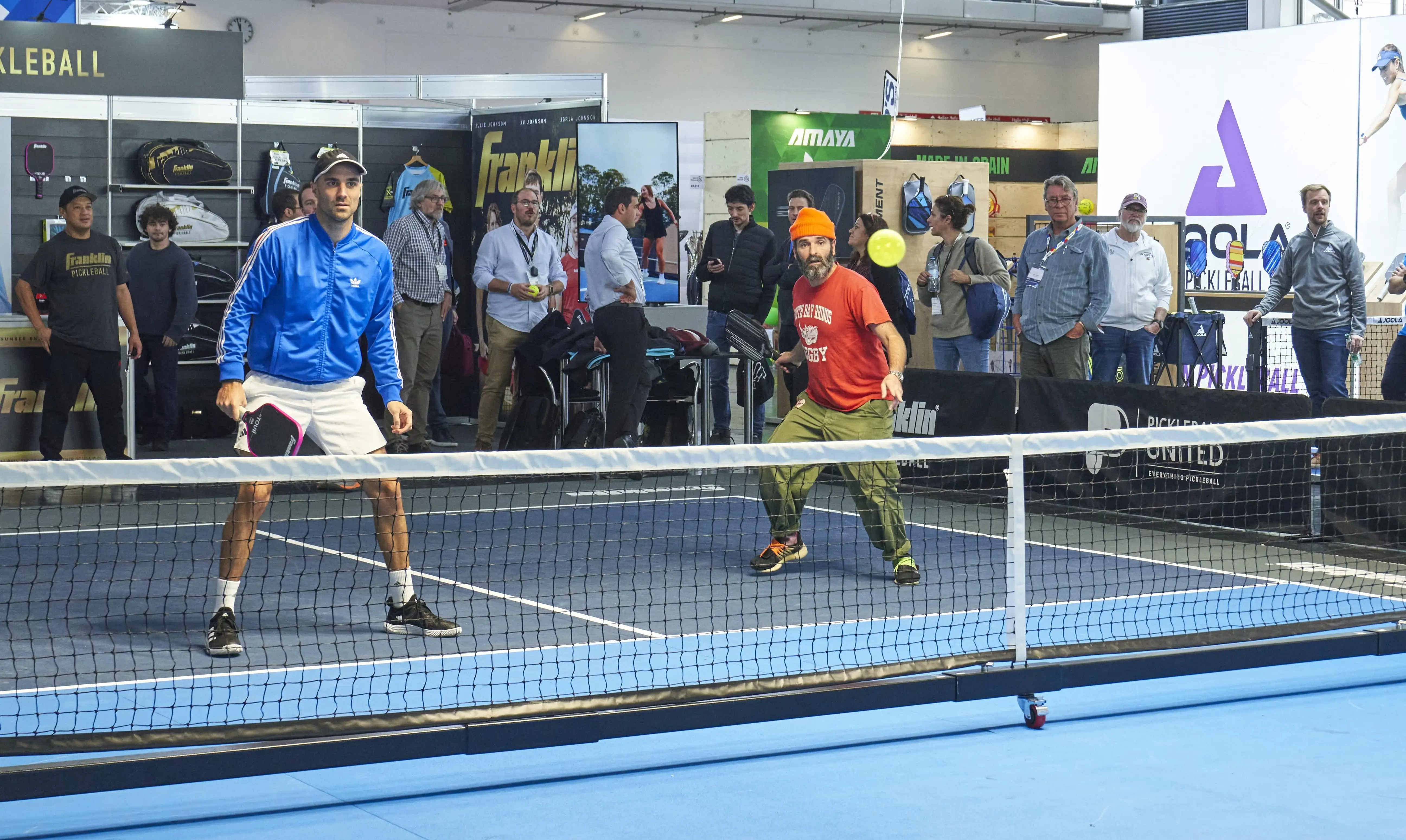
If you ask passers-by on the streets of Germany whether they know the sport of padel, the answer is still a shrug of the shoulders for many. Similarly, the success story of padel has not yet been adequately recognized by sports retailers or the sports media. But this will change quickly and, above all, drastically over the next few years. The first sports retailers are already stocking padel rackets and balls near the "tennis department". And as far as the growing number of padel facilities in Germany is concerned, the potential of padel can no longer be overlooked.
If you ask the aforementioned passer-by question in Spain, the answer will most likely include an invitation to play a match together. Because in Spain, over a million enthusiastic "padeleros" are already chasing after the yellow ball in the box - and they do so on over 16,000 padel courts spread across Spain. In comparison: in Germany, the still manageable fan community is currently content with just 500 padel courts, which are currently booked out accordingly when the weather permits a padel match. And all it takes is dry conditions and temperatures above zero degrees - because padel is a good option for having fun even in calm winter weather thanks to the windproof screens.
The sustainable boom in padel can also be explained by the fact that athletes who have a certain feel for the ball can experience exciting matches on the padel court after just a short time. Sports scientist and rebound sports coach Andreas Ehstand explains: "The stroke variations are usually much more compact and quicker to learn than in tennis, for example. What's more, the glass and metal court boundaries mean that the rallies can be much longer and therefore often subjectively much more exciting than in other backstroke sports. The teams of two on each side of the court - through constant verbal and non-verbal communication - lead to a much more social playing experience, which many players feel and carry on beyond the game, especially after Corona, in the entire social sports structure around the courts and in the often nearby sports restaurants."
Just how energetically padel is progressing worldwide has even attracted the attention of economic experts from Deloitte, who, together with the global booking and appointment platform Playtomic, have been approaching the phenomenon of padel from an economic perspective once a year for the past three years. The current edition of the report states that in 2023 alone, over 2,657 new padel clubs were opened worldwide - that equates to more than 50 new clubs per week. This dynamic shows how quickly the sport is establishing itself globally. It is particularly remarkable that the report for 2026 estimates a number of 70,000 (in 2023 there were 40,000) padel courts worldwide by 2026, which corresponds to an almost doubling of the current number of courts. Growth will be driven by the increasing demand for courts in new markets - particularly in countries where padel has only become popular in recent years, such as the USA, France and Germany.
The report particularly highlights the markets where padel is currently in a boom phase. Spain remains the Mecca of padel sports with over 16,000 courts in 2023, followed by countries such as Italy (6,470 courts) and Sweden (4,200 courts). It is interesting to note that padel is also establishing itself strongly in countries with colder climatic conditions, such as Finland and Norway. There are already more than 1,000 padel courts in operation there, although many of them are indoor courts.
Growth is particularly strong in Germany. While the country still lags behind the rest of Europe, there is enormous potential to catch up here. In 2023, the number of padel courts in Germany rose to 420, and the number of players licensed by the German Padel Association grew from 1,100 in 2022 to 2,500 in the following year. These increases indicate that Germany could play a central role in the European padel scene in the coming years. In addition to the German Padel Association (DPV), which is responsible for coach training, national teams and association matches and is part of the world federation FIP, the German Tennis Federation (DTB, the largest tennis federation in the world) has also discovered the enormous potential of padel. Those responsible at the DTB see excellent opportunities for established tennis clubs to breathe a new youthful and fun-oriented spirit into the club through additional padel courts and, in the long term, to inspire new target groups for the development of the sport of tennis with the padel offer.
The Global Padel Report not only sheds light on the development of new court construction, but also provides economic forecasts for operators and the sports industry.
In this year's edition of the report, the global padel market was estimated at 2 billion euros in 2023. This market includes revenue from court rental, the sale of rackets, balls and clothing. The sale of padel rackets in particular is booming: over 6 million padel rackets were sold worldwide in 2023. This shows how much interest there is in the sport and how much the industry around padel is growing.
The forecasts for the future are impressive: the global padel market is set to grow to 6 billion euros by 2026. This means a tripling of the current market value. Further growth is expected, particularly in new markets such as the USA and Germany, due to the sharp increase in new court construction and the growing community. This development has not gone unnoticed by established tennis brands. Almost all tennis brands now also offer padel equipment, mainly rackets, balls, bags and textiles, to their "backstroke sport customers". In addition to global players such as HEAD, WILSON and Babolat, a number of specialty brands are also very successful in the padel business, offering exclusively padel equipment. They are mostly based in Spain, as are most of the established court builders. However, these brands are still far from being established in the German sports retail market. Padel could therefore become a new niche for sports retailers in the medium term, generating good sales. Despite the compact and not very technical design of padel rackets, the branded products are usually significantly more expensive than, for example, tennis rackets from one label.
The opportunities for investors, agile tennis clubs, sports clubs and local authorities are excellent. However, there is currently still a lack of coaches, the involvement of schools and an even better established network for padel as a competitive sport similar to point matches in tennis. Business consultant and padel coach Arndt Schmidtmayer comments: "We are still at the beginning in Germany in terms of structures and the availability of padel expertise in the training sector. However, both the German Padel Association and the German Tennis Federation are actively involved in increasing the training sector. If padel is to become a real success story in Germany, both associations need to work better together and thus, among other things, raise the level of performance in competitive sport. This means focusing on young talent, integrating schools, but also further developing padel as an event and travel theme. This requires trainers and coaches as well as appropriate nationwide and professional digital training options".
One reason for padel's enduring popularity is the sport's strong social component. Padel is a team sport played mainly in doubles, which makes it particularly attractive for groups of friends and social activities. Many players appreciate the opportunity to play in different clubs and compete against different opponents. This contributes to the rapid development and consolidation of padel communities worldwide. This social dimension has also contributed to padel increasingly being perceived as a leisure and recreational sport. Particularly in countries such as Spain and Italy, padel is not just a sport for professionals, but also for people of all ages who enjoy exercise and social interaction. Padel communities are usually based on very agile WhatsApp groups. In the metropolitan regions, these sports groups have members in the four-digit range, mostly organized in large info groups and appointment communities of the facility operators. Anyone who actively participates in these groups and does not set the channel to mute usually has several options every day to spontaneously meet up with "strangers" on the court. Resourceful site operators also organize "Americanos", especially at weekends. In this type of tournament, matches are played for a limited time with alternating partners and the winner of the day is awarded to the participant who has won the most games. These tournaments are becoming increasingly popular and are offered in three to five game level categories, depending on the location and facility.
Padel has what it takes to be a "trend sport" in every respect, even though this attribute is avoided by the German Padel Association, for example. The fact is that padel has long been a national and international competitive sport, on television, as a streaming service and on social networks. Nevertheless, the development potential is very high. In addition to the commitment of major sports brands such as Adidas, Decathlon and Red Bull, numerous celebrity ambassadors from other sports who have outed themselves as real padel fans are also contributing to this. Whether tennis stars such as Rafael Nadal, Thommy Haas or Andy Murray or soccer icons Lionel Messi, Manuel Neuer or Jürgen Klopp: they have all been bitten by the bug and with the financially strong world association FIP from Qatar, Olympic ambitions are no longer unrealistic. It is therefore worthwhile for the sports industry, specialist sports retailers and not least the sports media to keep a very close eye on the further development of padel.

The current situation is complex: the Green Deal and discussions about sustainable design and duty of care are in full swing. For outdoor retailers, this means waiting to see the status quo while setting the course for the future.
Between the pressure to innovate and the survival trends of today, it is above all the customer experience and the skills of the sales staff will be decisive. If you want to be successful in the outdoor market tomorrow, you should take a look into the future now.
What factors will influence success in outdoor retail in the future? What new service concepts could emerge? And how can Gen Z be satisfied while at the same time winning over Gen Alpha? Is the classic loyalty program with financial incentives still the recipe for success?
Salespeople as brand ambassadors
Ecodesign: Longevity as a game changer
Physical longevity and emotional connection
Focus on the experience
Education first
The outdoor industry - ready for the future
Salespeople are the first interface between the brand and the customer - and can significantly influence the purchase decision through their expertise and enthusiasm. In the future, training in corporate social responsibility (CSR) and the introduction of the digital product passport (DPP) will be the focus. In future, salespeople will not only have to know the products, but also understand their social and environmental impact.
The most important requirements:
Christophe Cordonnier, co-founder of Lagoped™explains: "We have introduced an internal system to analyze the lifespan of our products in order to store all the data on our garments and accessories. This information ends up on an external computer that calculates the results. Our Eco-Scores are available on all sales channels - online, in the catalog and on hangtags. The Eco-Score is also an important training tool for our sales staff and retail partners."
Over the next few years, consumers will become better and better informed, which will fundamentally change their purchasing habits. This is also likely to lead to new types of customers - including the underconsumption core. It is estimated that Generation Alpha will have a purchasing power of around 5.5 trillion US dollars by 2030 (sources 1 and 2).
As part of the Green Deal and the new CSRD-guidelines, the measurement of product lifespan and performance will play a central role. The longer a product is used, the smaller its ecological footprint - a challenge for marketing, product development and customer communication. But how can this longevity be measured and communicated credibly?
One solution could be special workshops where consumers learn how to repair or upgrade their equipment themselves - supported by partners such as About a Worker or The Good Loop. Another approach is to collect customer reviews and feedback a year after purchase in order to gather valuable data on product usage.
Another exciting idea: smaller, specialized outdoor stores, for example in train stations on the way to ski resorts or coastal towns. These could focus on the essentials, offer rental equipment and serve as a return station for rented equipment - less bells and whistles, more service.
The extended producer responsibility (EPR) and new services for Circular Economy-products and packaging will profoundly change the retail sector. This is where the product life cycle plays a decisive role. In the future, QR codes on products could provide information about shelf life, care and recycling. RFID chips to indicate signs of wear and tear are also conceivable.
Cooperation with fitness apps that display the remaining lifespan of your running shoes and suggest the nearest repair service could also be a forward-looking service extension. Such offers will give classic customer loyalty programs a whole new meaning. Instead of financial incentives, the focus could be on training, events and promoting the outdoor community. Customers would become ambassadors for sustainability and cost efficiency.
Digital information, products or services: While Gen Z prefers prefers sharing consumptionGen Alpha lives the phygital concept - the fusion of physical and digital experiences. For them, the transition between e-commerce and physical stores is fluid; the key lies in the customer experience (CX).
This new target group, which will number over two billion adults by 2025, could have the greatest purchasing power in history. And a clear trend is emerging in the outdoor sector: from pure "ownership" to "experience". This means less focus on ownership and more on use. Renting instead of buying - even for personal equipment. Brands like Rip Curl already offer wetsuits for rent, Vaude rents out sleeping bags and sleeping mats, and Millet offers customized outdoor packages for hiking and skiing adventures.
Grégory Pouy, an expert in digital marketing strategies, says: "Gen Z and Gen Alpha are not opposed to each other. In times of major changes in values and beliefs, it's less about generations and more about awareness and the formation of new communities. Brands need to tailor their messages to the respective target group and take their customers by the hand to shape a new era together."
Some large retailers are diversifying their range and offering innovative B2B services. Brands such as Etam™ with the program Wedarelab or Decathlon™ with Pulse as start-up incubators. These programs offer not only a space for innovation development, but also a long-term investment strategy. Decathlon has invested around invested around 400 million euros in partnerships since 2018 - from collaborations with small companies to majority stakes in pure players such as Alltricks™ and Bergfreunde™.
But education also means sharing experiences in order to advance the social and ecological goals of the fashion industry. Thus Veja™ offers free events in its flagship stores - from book presentations to discussion panels on topics such as sustainability and fashion. Also Salomon™ is also committed to transparency and regularly publishes impact reports (sources 3). With a clear focus on recycling and repair, the brand has the UN's Sustainable Development Goals firmly in its sights.
Inclusion, sustainability, data-driven decisions and a culture of continuous learning: the outdoor industry has the potential to master the challenges of the future. As in sport, it depends on clarity of purpose, mental strength and long-term discipline to be successful. Sport and business often share the same principles. The outdoor world has all the prerequisites to establish a modern, resilient business model that meets the expectations of both customers and employees.
Sources

Under the motto “From Commitment to Action”, the Ski Industry Climate Summit by Atomic on December 2nd and 3rd at ISPO Munich will once again bring together the big players of the ski and snowboard world, invited by Atomic. Brands, manufacturers, retailers, associations and NGOs will all be there to forge innovative ideas for more climate protection. Jonas Schneider from Protect Our Winters (POW) explains why this meeting is so important for the industry.
Hardly any other sports industry is as directly affected by the effects of climate change as the ski and snowboard industry. When glaciers melt, seasons become ever shorter and snow increasingly has to be produced artificially in many places, the framework conditions for winter sports resorts and the winter sports industry alike change.
In order to start a movement for more climate protection in the industry, the first Ski Industry Climate Summit by Atomic took place last year in Salzburg at the invitation of Atomic. For the first time, leading international ski manufacturers, suppliers, retailers, trade associations, sports associations and climate protection organisations came together to define and initiate important joint measures for more climate protection. Presentations and workshops for all participants covered topics such as decarbonising the hardware supply chain, more sustainable product design, establishing a closed-loop system for sporting goods and setting up an impact measurement data management system.
After a successful kick-off, the Climate Summit is now entering its second round. And has chosen a platform that could hardly be more fitting: ISPO Munich 2024. Supported by the Federation of the European Sporting Goods Industry (FESI), Protect Our Winters (POW) and the European Outdoor Group (EOG), around 200 industry insiders from various sectors are expected at the ICM at the Munich Trade Fair Centre on 2 and 3 December.
We spoke to Jonas Schneider, Executive Director of Protect Our Winters (POW), about the results of the last climate summit, the next steps and why it is so important to attend.
The key takeaway was the realization that brands and manufacturers must make significant progress on decarbonizing the industry, which can only be achieved through collaboration. As often happens, a strong actor needs to take the first step, and it is great news that Atomic has committed to this role, dedicating the necessary resources to it.
As a sector directly impacted by climate change, the industry must act not only to safeguard its own future but also to recognize that the changes we all see in the mountains are just the beginning of the critical impacts already affecting less fortunate communities worldwide.
Collaboration between competitors is often challenging, so looking back, we can definitely say that the initial response and attendance were promising, if not overwhelming. The summit's achievements reflect the ski industry's commitment to meaningful change and reducing its climate impact.
We must first define the "industry." Currently, the summit involves the hard goods equipment sector, including brands, suppliers, and retailers. For this segment and the broader winter sports industry, the goal is to lead in climate action and transformation, inspiring the entire outdoor community.
As a small industry, success should be measured not just by progress but by how much we inspire a larger movement through our actions and communication. Ultimately, our shared goal is to shift the image of skiing, snowboarding and winter sports in general from climate change contributors to climate champions.
The guiding targets are those set by the Paris Climate Agreement and also the UNFCCC race to zero. Regulations in Europe and North America are primarily focused on material compliance, the circular economy, and communication transparency.
Collaboration leads to common standards, shared solutions, and more effective large-scale systems, which is crucial given the urgency of the climate crisis. The first Ski Climate Summit last autumn 203 in Salzburg marked a strong starting point. However, this is just the beginning—ongoing collaboration is essential, not just at these summits but even more in between, where the work leading to the next milestones must be done, such as for instance on common Life Cycle Assessments and take back schemes for recycling.
Bringing competitors together and creating a safe space for collaboration is never easy, but POW, as an NGO, contributes to the summit's success through its experience, working with many different stakeholders on the topic of sustainability and climate action. In addition, POW enables the industry, when it comes to sustainability, to act as one.
The Ski Industry Climate Summit by Atomic fostered a willingness among industry representatives to collaborate on climate challenges and raised awareness about data-driven climate action, resulting in the winter sports industry uniting around a transformative WSN Climate Pact. The summit also educated attendees on upcoming legislation and regulations, preparing them for future changes. It emphasized sustainable practices in material use, recycling systems, and industry standards, including efforts to harmonize data exchange and develop a product environmental footprint rule.
The framework is now well-defined, and the objectives are clear. Now we need to shift from commitment to action by together advancing circular systems, material standards, large-scale industrial transformation, and other key initiatives.
It is essential that all brands in the hard goods sector attend the next Ski Industry Climate Summit by Atomic in Munich, around ISPO. Participation benefits not only individual companies but the entire industry. No one can afford to miss the opportunity to shape the future of skiing and snowboarding. In fact, I would argue that every ski and snowboard brand has a moral obligation to be part of this movement, working together to become a sustainability role model.
Most major ski and snowboard brands have confirmed their attendance. Additionally, gear brands for helmets, poles, goggles, and other equipment have been newly invited.

The sports industry is booming-learn how you can be part of its billion-dollar growth with these strategic tips. This dynamic field offers countless job prospects, company locations, and promising earning opportunities. The Sports Sector is Expected to Reach $623.63 Billion in 2027 at a CAGR of 5 percent. The biggest problem, however, is that this rather opaque field has a highly competitive entry process, unlike more conventional industries. Therefore, strategic planning and a proactive approach are necessary. Here are 10 tips to help YOU establish yourself in the sports industry, along with insights into popular careers within this field.
➡️ Best Paying Sports Jobs 2024
ISPO gives you the chance to explore a variety of information stands on the latest trends in the sports industry and make valuable connections. Take the opportunity to learnabout different career paths, speak with industry experts, and expand your professional opportunities. Visit ISPO to elevate your career in the sports sector.