

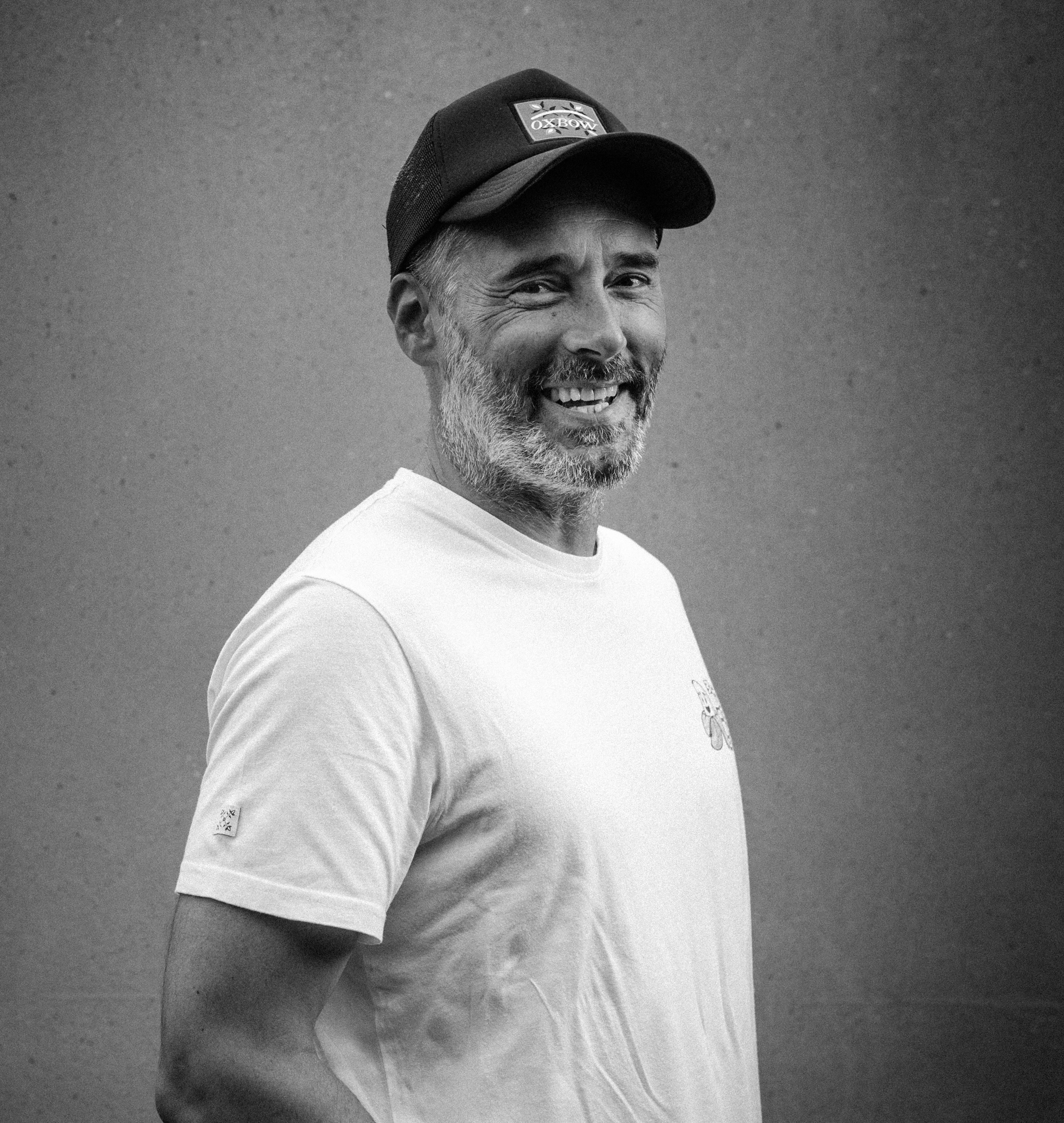
Oxbow, the iconic surfwear brand from France, has not only made a name for itself with its colorful and functional designs, but also with its strong commitment to sustainability. In an exclusive interview, CEO Emmanuel Debruères reveals what the "Stoked Planet" environmental program is all about, how Oxbow is reviving the cult 1985 and Collector collections and why the future of Oxbow remains so exciting. What motivates the CEO and what does the future of the outdoor industry look like?
Founded in 1985,Oxbow is a French surfwear brand known for its colorful, high-quality and functional designs. Since its inception, Oxbow has become a major name in the surf community and has continuously expanded its product range to include clothing and accessories for mountain and water sports. With a strong commitment to sustainability and responsibility, the brand supports numerous events and athletes worldwide.
Emmanuel Debruères, the new CEO of Oxbow, is a passionate sportsman from the Alps who previously worked at Billabong and Dakine. He began his career at Rossignol and Salomon in France and gained experience in the USA before taking over the Oxbow brand together with Jean-Christophe Chetail in 2020.
My main motivation was my passion for snowboarding and surfing. Then there's my admiration for the Oxbow brand, which made me dream in the 90s, and the opportunity to take my professional destiny into my own hands.
Stoked Planet is our program for environmental commitment and protection. It encompasses all the measures and actions we have taken over the past four years and will implement in the future. We are focusing in particular on reducing CO₂ emissions in line with the Paris Agreement and protecting drinking water resources.
Technical products are an essential part of a sports brand's offering. That's why we at Oxbow develop and market a wide range of products for use in the ocean and in the mountains. This includes wetsuits, boardshorts and innovative outdoor clothing that offer athletes the best conditions. The Collector™ collection is a tribute to our product and graphic DNA and contributes to the revival of French textile production, as all products are made in France.
The outdoor industry is growing dynamically as more and more people want to enjoy nature in summer and winter, in the water and in the mountains. COVID has brought the joy of outdoor activities closer to many. Our mission is to use the limited resources of our planet responsibly.
We develop many innovative products, both technically and in terms of ecological responsibility. We achieve this through strong partnerships with our manufacturers, which give us access to the necessary research and development. For example, we have been able to develop Yulex wetsuits and upcycled board shorts made in France.
Sustainability is a matter of course at Oxbow. Our uniqueness lies in offering our customers the products they need for action sports and at the same time conveying the dream of unique experiences in surfing, snowboarding and other sliding sports. We support outdoor fans so that they can experience their passion as intensively as possible.
Our ambassadors embody Oxbow in the mountains and in the water and convey the brand's values of freedom, fun and environmental responsibility. They are indispensable for the further development of our technical products and help us to make strategic decisions in areas such as environmental protection. We document and share their adventures to inspire enthusiasm for new experiences.
The B Corp certification is the most comprehensive recognition of our efforts in the area of Corporate Social Responsibility (CSR) and makes them comprehensible to consumers. It is a strong commitment by the brand to a long-term CSR policy. Nevertheless, it is not an end goal, but just another step on the way to a better world.
It requires a great deal of persuasion and independence from purely financial constraints. For Oxbow, this is a civic, environmentally responsible and historic approach. We make products like the iconic Oxbow sweater with long-standing partners like Société REGAIN™. Local commitment means that too!
The outdoor sports industry has a promising future. It is important to sustain growth, maintain playing surfaces and invest in marketing to evoke the desired emotions in fans. Oxbow shares these challenges, but has the advantage that we can make our own decisions without being subject to extreme financial constraints.
The Olympics is a bigger event that doesn't affect us much. The competition is only a small part of the universe of action sports for Oxbow. The anti-culture of surfing and snowboarding, which is characterized by creativity and freedom, contradicts the conformist image of the Olympic Games.

One record chases the next when it comes to female sports sponsorship. Olympia 2024 starts with 50 percent female athletes. Revenue from professional women's sport surpasses the one billion US dollar mark. And the streaming figures for women's sports competitions are raising the bar year after year. We want to celebrate that. But: female professional athletes are still lagging far behind the sponsorship income of their male colleagues. There are many reasons for this, but there is hope. After all, interest in sporting events with female athletes is not only growing, but it is also extremely lucrative to invest in female professional sport.
According to the Deloitte forecast, a sharp increase in commercial revenue (club sponsorship, partnerships and merchandising sales) is currently the biggest growth driver in women's professional sport - with estimated total revenue of USD 696 million. This is followed by income from broadcasts (USD 340 million) and match days (USD 240 million). The largest market is still North America (52%), followed by Europe (14%).
The two most valuable sports are expected to be soccer (43%) and basketball (28%). And: global competitions generate the most revenue. The consultancy firm mentions the FIFA Women's World Cup, the Ladies Professional Golf Association (LPGA) Tour and the Women's Tennis Association (WTA) Tour. They are expected to contribute 425 million US dollars (33 percent) to the forecast total volume.
Of course, we are celebrating the breaking of the one billion US dollar mark in revenue for female professional sport. Nevertheless, revenue in male professional sport has only been going in one direction for years - upwards. We are talking about an estimated 64 billion US dollars in 2023.
In 2024, women's professional sport will continue to benefit from the multi-faceted success of the FIFA Women's World Cup 2023, according to the consulting firm Deloitte, which estimated revenues of more than 570 million US dollars. Even though women's elite sport is developing rapidly, it is still in the early stages: the consultancy firm cites the fact that many of the major leagues are very young and that a mainstream culture around women's elite sport has yet to develop in many countries. Hans-Willy Brockes, founder of the ESB Marketing Network, agrees: Women's sport had "less importance culturally and historically and is still not promoted in some societies today." This lagging behind cannot be made up for in just a few years, but is a generational issue.
"The gender pay gap is not just about sponsorship, but also about bonuses and employment contracts for professional athletes. First of all, you have to say in general that there are huge pay gaps in sport," Brockes states. According to him, these exist in particular between sports: soccer on the one hand and volleyball, field hockey or artistic gymnastics on the other. This raises the question of the justification for the pay gap. "The answer is market rationality. Supply and demand exist in sport and also in sports sponsorship. Both in terms of athletes (employment contracts) and performance (TV ratings/social media followers) or the marketability of sponsorship and ticket sales."
According to UN Women, for the first time in history, there will be as many female athletes as male athletes competing at the 2024 Olympic Games in Paris. This means that sports fans around the world will see more women than ever before presenting their sports and, of course, the respective brands at world level. When women were allowed to take part in the modern Olympic Games for the first time in 1900, they accounted for 2.2 percent of all participating athletes. This milestone is thanks to the tireless efforts of female athletes who are breaking records, overcoming stereotypes and inspiring future generations.
The young US company Sponsor United, which operates a global sports and entertainment SaaS platform, cannot get past female stars in an analysis in the run-up to the Olympic Games. On the contrary. It names three successful US female athletes who shine with their sponsorship contracts and social media followers: Gymnast Simone Biles, tennis player Coco Gauff and swimmer Katie Ledecky. The Athleta brand, itself brand new to Olympic sponsorship, is certainly delighted. Gap's premium performance lifestyle brand from the USA is relying on Simone Biles as a brand ambassador for its "Power of She" platform to support athletic women and girls. The campaign also features Katie Ledecky.
Also in the spotlight: British skateboarder Sky Brown - just 16 years old. Sponsor United calls her a "trailblazing global athlete".
Not only is the 2024 Olympics setting records, but the visibility of women is also (slowly) improving. The UK Women's Sport Trust's latest study into the visibility and popularity of women's sport concludes: "This report points to unprecedented streaming figures in the digital space as well as record usage of videos of leading women's sport competitions on social media channels," said Tammy Parlour, CEO and co-founder of the Women's Sport Trust. "The industry needs to seize these opportunities to further increase awareness and engagement so that we can continue to grow the audience for women's sport and reach fans where they are."
How are teenage girls, young women and best agers supposed to perceive female role models if they pursue their sport unnoticed by the media? Participants in a survey conducted by the German sports marketing agency ONE8Y named more coverage of women's sport (53%) as the most important way of getting female fans more involved in sport. This was followed by the desire for more female commentators (38%) and more events specifically for women (37%). ESB boss Brockes says: "That says it all. The interest is not (yet) being met. And so you also have to scold the media. They are also 'somewhat' to blame..."
"We have set ourselves the long-term goal of distributing investments in male and female professional sport equally. The proportion of contracts with female athletes has been rising steadily for years," says an Adidas company spokesperson. The German global company also knows: "The media presence and public perception of sport is largely focused on male athletes. We have made it our goal to promote equality in sport and to be present in women's sport with our brand."
Other brands also recognize the value of young, marketable professional female athletes. Forbes magazine mentions Angel Reese and Cameron Brink in the WNBA, Nelly Korda and Rose Zhang in golf and Iga Swiatek, Coco Gauff and Aryna Sabalenka in tennis. According to a recent analysis by Sponsor United, Swiatek is in third place worldwide in terms of brand engagement in social media behind the two basketball players Giannis Antetokounmpo and Stephen Curry.
Under Armour has been consistently focusing on female testimonials for some time now. The US company launched its first global advertising campaign aimed specifically at women back in 2014. Ballerina Misty Copeland, Olympic soccer gold medal winner Kelley O'Hara and professional surfer Brianna Cope were delighted to receive sponsorship money. Now comes the next big thing: in June 2024, USA Football, the governing body of football in the USA, and the organization responsible for the formation and management of the US national teams announced a multi-year partnership until the 2028 Summer Olympics. The aim of the partnership is to enable all athletes (male and female) to participate and to promote football. Smaller sports companies also rely on the appeal of female athletes: The still young German sportswear brand Ryzon currently sponsors eight professional female athletes (and nine professional male athletes). The first to put on Ryzon clothing was Imogen Simmonds, British-Swiss triathlete and European Ironman champion in 2019. She is still on board. The latest coup: current Ironman world champion Lucy Charles-Barclay has been under contract since April 2024.
The value of sponsorship in women's elite sport is likely to increase rapidly by the end of 2024, predicts Deloitte. The reason: impressive recent evidence of return on investment. According to one study, for every dollar spent by a corporate sponsor in women's sports, more than seven dollars in "customer value is generated for that organization." Some sponsors of the Ladies Professional Golf Association (LPGA) reported a return of up to 400 percent of the media value of their investment. Between 2019 and 2023, the LPGA also doubled the number of active brands on its sponsor list, and in June 2023 the number of sponsors exceeded the 1,000 mark for the first time. ESB CEO Brockes also sees "momentum for women's sport". Soccer is definitely benefiting from this. It is particularly noteworthy that new sponsors such as Vorwerk and Stepstone are getting involved in this way. "But I also see good demand from sponsorship partners in tennis, golf and Nordic winter sports."
In its latest market report, Sponsor United also sees an upturn in women's sponsorship and explains this in part with double-team deals, for example in the English capital London. According to the results, men's teams have an average of 42 sponsors ("a modest increase" of 2.5% compared to 2022), while women's teams are on the rise with an increase of 35% since 2022. This increase in women's sponsorship deals is partly due to the growing trend towards bundled sponsorship deals. For example, according to Sponsor United, 79% and 88% of sponsors of Arsenal and Tottenham Hotspur's women's teams respectively are also partners of the men's teams. These results would suggest that brands are increasingly recognizing the value of sponsoring two teams and are using both the men's and women's teams to maximize market reach and engagement.
It is not only the higher return on investment that speaks in favor of sponsoring female professional sport, but also a better image: The British Women's Sport Trust found that 29 percent of consumers have a more positive opinion of companies or brands that support women's sport through their sponsorship, twelve percent more than for campaigns that support men's sport. In addition, women-only sports contracts have been shown to be popular due to their ability to attract new audiences and increase brand affinity. Tammy Parlour from the Women's Sport Trust: "This new study clearly shows the positive impact brands can achieve when they invest in sponsoring women's sport."

Sports sponsorship once began with the labeling of jerseys, boards and ballpoint pens. Today, social media, sustainability aspects and many new sponsorship activations are standard. Hans-Willy Brockes, CEO of ESB Marketing Netzwerk and organizer of the SPORT MARKE MEDIEN congress, shows how current trends are driving further strong growth in sports sponsorship.

High inflation, full warehouses, reluctance to buy - the current market situation in the outdoor industry is complex. Sometimes it helps to think outside the box and look at what others are doing. After all, community and exchange are two things that we humans fall back on, especially in difficult times. How the North American market is currently ticking, what challenges and opportunities retailers are facing there and how resourceful retailers can learn from them.
In a deep dive into the market and the circumstances, expert Jeff Carter gives us some insights. He is Director of Merchandising for the US retailer Mast General Store, which operates ten stores in four different US states. The company has been around since 1883, and the storytelling in stationary retail is also based on its long history. Creaky wooden floors, antique curiosities on the wall, sweets at the counter - when you enter the stores, you embark on a journey through time.
Jeff describes this approach as experiential retail. The heart of the retail chain is the head office, on the basis of which the other stores were designed. "As a general store, we traditionally had everything from the cradle to the coffin. And even today, we have something for everyone - from outdoor equipment and clothing to old-school sweets."
Retail as a special experience therefore takes center stage. "We focus strongly on the guest experience, as we call our customers." The in-store experience should feel like an invitation home. "That's exactly how we want to treat people in-store and offer them an experience that they don't get in typical retail stores." A high number of customer advisors on the floor convey a high-quality shopping experience. "I would summarize our concept under the slogan 'personal service with a nostalgic flair'."
Personal service plays a particularly important role here, also as a driver of loyalty. As in Europe, expertise and individual adaptation to the needs of the target group pay off. Personal customer relationships are also the keyword in the Mast General stores, which sets them apart from large department stores. Although the retailer also has an e-commerce platform, the focus is on personal contact. Accordingly, there is intensive customer care instead of self-service check-outs.
This makes perfect sense for the brick-and-mortar retailer, as the stores are located in the immediate vicinity of the Appalachian Trail, offering product demonstrations and community events, as well as supporting various events in the area. The specialist expertise in the footwear sector, more specifically in individual fitting, also pays off. "Most of our sales partners work with us on in-store training and in-store demonstrations. Our employees are therefore very, very well trained when it comes to fitting shoes," says Jeff, explaining another touchpoint where a loyal customer base can be built up. As also described in the Deloitte Retail Industry Outlook for 2024, loyalty is currently an important factor.
When it comes to ordering, trade shows are still essential for the 18-strong team in Purchasing, which Jeff heads up.
In addition to community activations and offers to strengthen customer loyalty, further strategies are currently needed to attract price-conscious customers. Jeff Carter sees this as the biggest challenge at the moment.
"What we have noticed in the last 18 months is a price sensitivity among customers that we have never experienced before. Of course, we've all seen some surprising increases during COVID. Consumers now have to decide differently than before what kind of products they want to buy and how much they need to buy."
Jeff believes it is important to include products at entry-level price points and in the composition of the range in order to generate growth. "We have had to reposition some brands and look for brands in the lower price segment to show our guests that we have something for everyone."
However, there is still a market for high-end and technical products. "While we are finding that the higher price point is holding its own with its existing customers, the growth for us is in the lower price point brands that we are now bringing into stores." While Mast General Store relies on strong and long-standing relationships with its suppliers, it has worked closely together on a brand basis to offer more products in the entry-level price segment. At the same time, it is always a good idea to remain open to innovations or appealing offers from new brands.
As far as innovations are concerned, Jeff Carter sees sustainability as a topic that does not yet have the same weighting in outdoor retail in the USA as it does in Europe, especially in the trade show sector. He explains this using the example of OutDoor 2023: "The show and also the exhibitors* are much more focused on sustainability than what I've seen, at least in our part of the States and at the shows we go to. While we certainly talk about it, so far it's not happening with the emphasis that I've seen here."
Jeff also sees this as an advantage for all retailers looking into the issue. "I know our company has always focused on being environmentally friendly and supporting our suppliers who are not. OutDoor has once again reinforced and encouraged me in this respect. The most important thing I've taken away so far is the focus on sustainability and the real opportunity we still have in the States to make this a bigger priority for us."
He sees a greater focus on green issues, particularly among younger target groups - including a willingness to pay more for a more sustainable product. There is a greater interest in companies, whether brands or retailers, that attach importance to doing business in a more environmentally friendly way.
At the same time, a general shift in the mindset of outdoor customers can also be observed in the US market. The big buzzword: athleisure. "It's much more casual and fashion-focused, even with most of our outdoor brands, even if they still have technical aspects. Many of them have moved towards fashion. And I think that's what our customers want too. It's no longer as important how quickly a shirt dries as it is what they like." Style and cut are therefore playing an increasingly important role, whether in combination with the function of the garment or as a primary aspect of it.
The multisport aspect of the equipment is just as important - "the younger target group in particular pays attention to this." Particularly because rental and second-hand equipment do not play a major role in the Mast General Store area, a wide range of uses for equipment is also an argument in terms of more sustainable purchasing behavior.

Sports tourism stands out as one of the most promising industries, continually expanding with many opportunities for breakthrough success. Attention: our latest lineup of cutting-edge strategies in the sports tourism sector is your ticket to staying ahead of the game. Seizing the demands of today's dynamic sports tourism market is now within your reach, and with a well-crafted plan, your path to success will be paved.
Kicking off the list is a rising star in sports tourism: eSport events. This new sports tourism industry has been propelled to insane popularity, and everyone is in a race to create the best hub for eSport tournaments and events. Crafting a state-of-the-art -Sport destination can propel your sports tourism credentials to new heights, offering users an immersive experience that truly stands out. Shining on the global sports tourism stage is now easier than ever thanks to the emergence of eSports, and investing in this area of sports tourism is a no-brainer, since it’s only going on an upward trend.
Besides this exciting new tourism landscape, there are three other key types of sport tourism that sporting goods professionals can leverage to diversify their offerings.
1. Passive sports tourism: Passive sports tourism involves spectating at prestigious events rather than participating, such as the Olympic Games, World Cup matches, and the Super Bowl. These events not only captivate audiences but also spawn numerous secondary sports tourism opportunities.
2. Nostalgia tourism: Lastly, die-hard sport fans keep the nostalgia tourism alive, like visiting the Baseball Hall of Fame or the Maracana stadium in Rio de Janeiro.
3. Active sports tourism: Active sports tourism, on the other hand, calls for a different kind of sports enthusiast. A lot of tourists will travel solely to participate in a bucket list event, such as the New York City Marathon. These occasions are a goldmine for sporting professionals, attracting both amateurs and seasoned athletes alike. Equally popular are sportainment and active events, with a rising trend in adrenaline-pumping sports tourism activities such as bungee jumping and skydiving.
The future of sports tourism is being forged by passionate sporting goods professionals and enthusiasts who are investing heavily in this dynamic industry. Looking forward, the opportunities are exceptionally bright. Sports tourism transcends mere athletics; it builds communities and fosters connections through the blend of tourism and sports.
The real treasure lies in the immersive experience of engaging in sports tourism activities. Therefore, focusing on crafting an unforgettable experience for tourists will establish you as a trailblazing sporting goods professional—a distinction that carries immense value.