

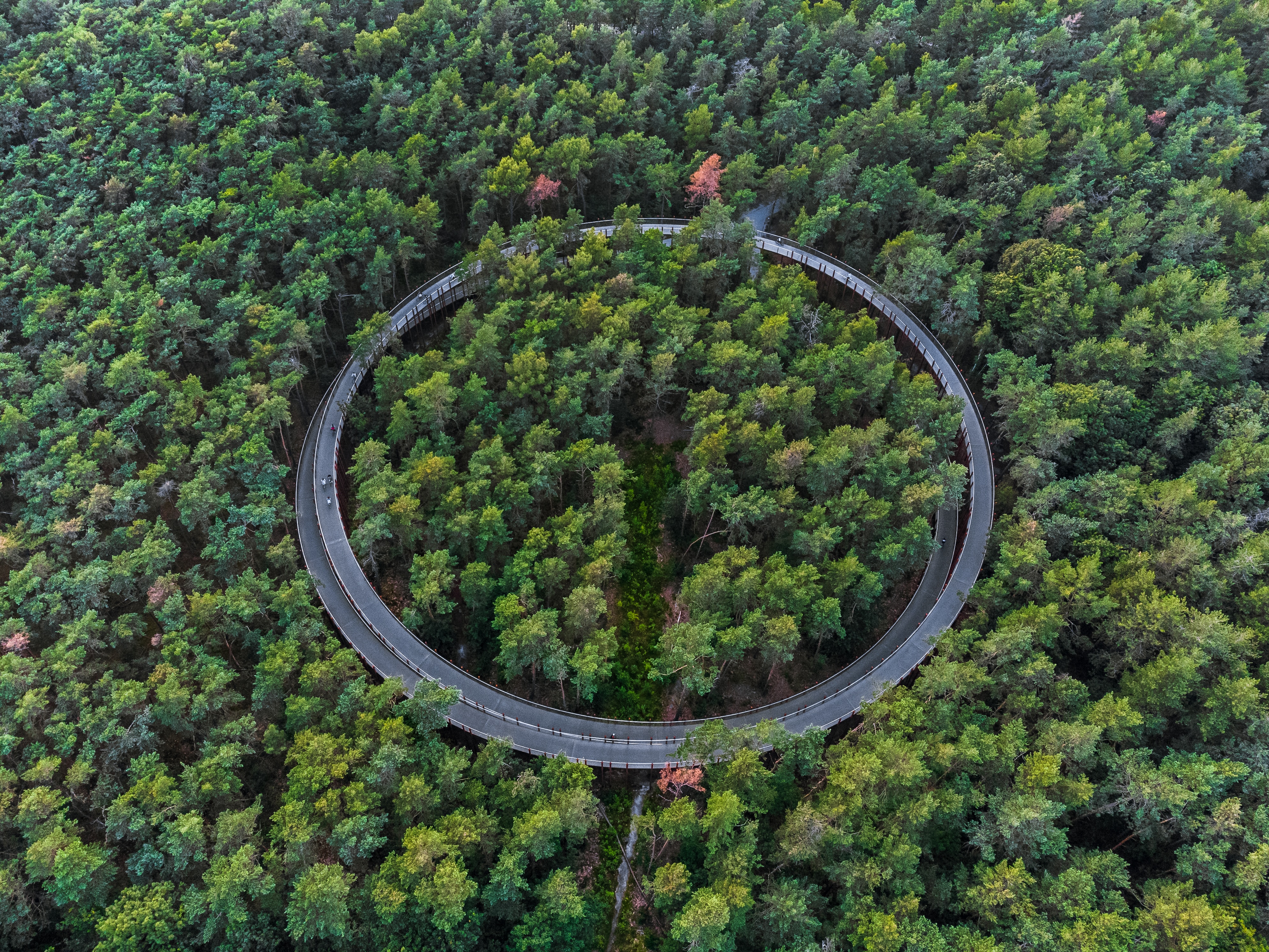
Sustainability, sustainability and more sustainability. Everyone is talking about it! No more buzzword bingo, it's time to make a difference. We're going in circles - but the solution is called circularity. But how can the outdoor industry make it a reality? The Sustainability Hub at OutDoor by ISPO 2023 provided answers. Now it's up to the industry to listen.
"For the outdoor industry, circularity is especially important because we want to get people outside to enjoy nature." With that, Virginia Schraml of HEIMPLANET makes it clear that if we destroy nature with our actions, we as an outdoor industry are clearly missing our vision. The only chance for a future for the industry and nature is to break away from linear business models and make the end of a product life cycle the beginning of a new one.
One of the most important factors for making circularity finally work is provided by Petra Schweiger, Director Europe of Accelerating Circularity Europe in the panel "Sympatex x Accelerating Circularity Europe (ACPE): Challenges and opportunities of the circular economy." ACPE is a non-profit organization that serves as a catalyst for new circular supply chains and business models. Its' goal: transforming end-of-life textiles into common raw materials. ACPE cooperates with numerous actors along the supply chain and knows that the most important first step is that everyone in the loop knows what impact he or she has on the circular system and what one needs to do to play a sustainable part in a functioning circular economy.
Does everyone really already know what really needs to be done?
The future is now: circular economy on the rise
When two industries meet and create a visionary network, it is clear: New ideas and solutions are now emerging! And for one of the most relevant topics in the circular economy: recycling. In the new, innovative Cross Industry Panel "Recycling strategies in the sporting goods industry - what's up? Status quo, opinions and solutions", Dr.-Ing. Julia Hobohm, Executive Board, IFAT worldwide and Kim Scholze, CSMO, Symptax spoke to each other. Why? To get to the bottom of the major problems of our time, such as climate change, waste and pollution. It became clear how important the exchange of knowledge between the industries is.
According to recycling expert Julia Hobohm, there are three ways to promote circularity and reduce waste:
But what is the problem with recycling now? In the "Outdoor Industry Approach to Circular Business Models" Jane Turnbull, Sustainability Project Manager of the European Outdoor Group presents exciting results from an EOG survey.
"Who collects, sorts and recycles?", asks Kim Scholze, CSMO, Symptax. Rightly so, because as the EOG figures show, a lack of infrastructure and a lack of suitable partners are the second and third most relevant reasons for brands not to offer recycling services. Projects like ACPE are therefore also important factors and key players in the circular economy game for Kim Scholze.
"Our products are way too complicated to recycle!" According to Jane Turnbull, this is the answer most brands give when asked why they don't recycle or what challenges they face. That overly complex products are one of the main reasons for a lack of recycling is also emphasized by Julia Hobohm: "Performance clothing often consists of up to six different materials," she explains. Among them metals or sensor technology. A nightmare for recycling.
"Waste management is always money." Good recycling costs money, expert Hobohm points out. And that's the Main Challenge according to the expert. This factor also comes to mind in the EOG survey. However, the money needed at the end of the life cycle is reduced if efficient production for recycling takes place at the beginning, says Julia Hobohm.
Three words that Kim Scholze always emphasizes in the context of the problems: DESIGN FOR RECYCLING! A solution lies in the first step of the supply chain. And this is where mono-materials and natural fibers come into play. A well thought-out design is therefore essential for circularity. Products must already be designed in such a way that their resources can easily be kept in a closed loop. Products made from mono-materials are the easiest, most efficient and cost-effective to recycle, says Hobohm: "Designers and producers must go hand in hand with recycling plans.
Petra Schweiger from ACPE also made it clear in her presentation that there are recyclers in Europe, especially chemical recyclers, who are just waiting to enter into cooperation with brands – including those from the outdoor industry. Nevertheless, the EOG results show that one of the most relevant factors why Brand does not recycle is the lack of suitable partners and the complexity of the infrastructure.
One company from the Sustainabiliy Hub that has had experience with the process itself is HEIMPLANET. As a sustainable outdoor brand, they create a small circular miracle with their backpacks made purely of mono-material. Virginia Schraml knows the challenges well: "This whole system is still in its infancy, because the recyclers are not yet prepared for it and certain quantities are also necessary. But we are also in talks with partners who also take back smaller quantities. It's the same with the backpacks. They can be sent back to us, we collect them, wait until we have a certain amount and then take them to the recycler to reuse the material."
Circularity, modularity and adaptability. This keeps the sports industry fit for the futureForward with circularity! How secondhand promotes circularity
Recyclers are waiting for brands, brands are looking for recyclers. The solution seems simple, doesn't it?
Gabriel Arthur, Chief editor, SUSTON shares in the panel "From Sustainability to Regeneration" what the next step of the industry is: Collaborations! Collaborations of all kinds, between brands, recyclers, collectors, and even between competitors. This is the only way to achieve circularity and thus a genuine circular economy. And for this, the outdoor community must be taken by the hand and guided.
For Kim Scholze, too, it's clear that everyone has a different idea of what a functioning circular economy is and that each individual is part of the solution. What will make the difference from now on: whether the industry is just talking, or is finally getting started. "Working on sustainbailiy is fucking hard." Sums up Prof. Dr. Tobias Luthe, PhD. DRRS Program Director, Professor, Co-Founder, ETH Zurich, AHO Oslo, MonViso Institute sums it up. That's why the next booster for a sustainable future is cohesion. ACPE also shares their vision: we need to understand together what needs to be done, we need to learn together from each other, we need to experiment together. And even though it will be hard for a while: We need to leave linear models behind together.
10 winter audience favorites at ISPO Munich
All fire from the Sustainability Hub
17 brands that offer repair services
Current Consumer Behavior: 7 Facts About the New Green Fatigue

In a world where overproduction and environmental pollution are the order of the day, Picture Organic Clothing is making a strong statement. "Make sobriety the new cool!" - with this provocative motto, CEO Julien Durant challenges the industry to seriously rethink its ecological footprint.
Julien Durant, Jérémy Rochette and Vincent André founded the Picture Organic Clothing™ label in 2008. As passionate skateboarders and snowboarders, they wanted to create an outdoor sports brand that invests in sustainability and continuous progress. What sets Picture apart is a strong and committed company culture that brings a modern and playful style to the often sober outdoor industry. The brand is also focused on preparing for the challenges posed by EU regulation and the goals of improving transparency.
We spoke to Julien Durant, who stands for modern management and the promise of a responsible employer brand. The CEO of Picture tells us about his career, the drive for entrepreneurship and the clear value proposition: Ride, Protect & Share.
"Jérémy, Vincent and I share a love of skiing, mountains and the sea! And we had the dream of being able to make a living from our passion. All three of us were in Clermont-Ferrand and wanted to create something that didn't yet exist. At the time, Jérémy was an architect, his whole family came from the construction industry, and he worked as a site manager alongside his studies. Vincent was the youngest. When Picture was founded, he was just 19 years old. I had gone to business school and worked in product marketing in the food industry. All three of us were fans of collaborative and authentic brands like Volcom™ or Burton™. At that time, Patagonia™ was still a very engaged brand aimed at an older community than today.
So we created a board brand with products made from 100% organic and recycled materials and with a radical value proposition. Our CSR strategy was clear and visionary: if a product couldn't meet our criteria, we wouldn't make it. We felt the need and saw the necessity to get involved in the mountain sports action scene. This allowed us to stand out from the crowd."
"We wouldn't change much, because every step has brought us further. By making mistakes, you learn to rethink apparent certainties. We were able to develop further through "test and learn" and thanks to contacts with CEOs from the industry: Jean-Marc Pambet from Salomon, Douglas Tompkins from The North Face and Georges Pessey, the founder of the development studio Jonathan & Fletcher, were important encounters. There are more highs than lows, and the biggest challenge is people! For a company, a sense of belonging is of the utmost importance.
We are 100 people in the head office and our products are distributed in four countries with 2500 sales outlets. These are enormous challenges for HR, whether on a rational or emotional level. We have to invest a lot in team onboarding to anchor the employees in the corporate strategy. After the start, the B Corp™ certification was a step that brought a lot of structure for everyone. We have recently been certified again and have improved several points. Today, B Corp has become a second source of motivation for our vision and we continue to communicate this to our teams. Most of the challenges we face are systemic. Fortunately, we have been able to break out of some of the clichés of responsible business models."
"It is clear that by 2030, brands that are not committed to the environment will be squeezed out, except perhaps at very low prices. To stay in the market, you have to separate CSR commitment and attractiveness. Attractiveness means that young people want to consume a certain brand in order to get the older generations to buy it as well. CSR is the action and progress of business models that are based less on volume and more on the processing of materials and products. Today, CSR means being avant-garde and having B2B legitimacy. We try to maintain this link by separating CSR and attractiveness. We are also working on new levers, such as offering products in segments that are not dependent on snow, like the hiking collection we are currently launching. The question we always ask ourselves is: how can we emphasize the brand's commitment right from the start? And we do this by working with all our stakeholders to develop a business model that reduces volume growth, accelerates circularity and stays close to people and nature - all for more economical and fairer consumption."
"Consumers everywhere are being put off by greenwashing. If we want to be recognized for our social and environmental responsibility, the background, the product and the communication message have to be right. Transparency is key here, and we need to be one step ahead for a clear commitment. At Picture, we discuss project challenges and how we can make progress. In terms of clear communication, we are sometimes a benchmark for transparency in the B2B OutDoor market.
We also often hear criticism about sourcing from distant countries, although certain business models do not allow for manufacturing in France. For example, we have wholesale distribution and are sold in several countries, which requires a cascade in terms of margins. We sell very little via D2C. Our sustainable price-performance ratio is based on our international business model, localized sourcing and local production, physical durability and use/maintenance of our items.
In addition, we should only compare what is comparable: according to our Scope 3 carbon footprint, only 1.5 percent of our model's CO2 emissions are transportation-related. What also counts are the social aspects. For this reason, we joined forces with the Fair Wear Foundation at a very early stage. The work behind the scenes in advance is crucial here: above all, we try to observe the same values everywhere globally in order to avoid and regulate overproduction."
"We differentiate between two worlds: On the one hand, the arrogant, performance-oriented outdoor, and on the other, the playful outdoor with a board culture that is not taken too seriously. The playful outdoor is our DNA: action sports in the outdoor sector. We want to strengthen our communication about these unconventional sides and dedicate ourselves to making outdoor products that fit.
At Picture, we are committed to the community aspect. Making a brand desirable is more difficult when you make colorful and playful technical products. We first have to bring our consumers into our community through different actions.
Playing with the quality moment is not an achievement in itself. We need to offer high-performance but not hyper-performance product ranges, as this is not our differentiator and is not expected of us. Our customers follow us because of our accessible and playful dimension. For our part, we try to spread the message: Make Sobriety the new cool - Make sobriety the new cool and make it a cultural norm."
"5R stands for Reduce, Reuse, Repair, Rent, Recycle and the program has been in place for a year."
"Florian Palluel, our Sustainable Development Officer, makes sure that our teams commit to deadlines - for collective success. Initially, I was reluctant to get involved with organizations because I think it's often just about soothing your conscience. I prefer concrete measures. Then Florian told me about En Mode Climat. The association of fashion brands acts as a coalition with working groups and is committed to responsible lobbying and combating environmental impact through legislative changes. We contribute by giving Florian time off, funded by Picture, to take part in tangible actions. Together with En Mode Climat's HR and recruitment teams, he is investing his time to change the rules of the game for the industry. Their aim is to attract major brands and incorporate new parameters for longevity, even if they are not mandatory from a political point of view. And it comes up with valuable proposals in terms of reducing the carbon footprint."
"The regenerative business gives back more than what it consumes. Our brand will never have a regenerative business model because we consume something and produce an item. We participate as a contributing company, not as a regenerative one in the sense of regenerative agriculture, for example. We implement certain aspects of responsible value creation. In the textile sector, this is limited and not yet fully developed, as technology and innovation have yet to initiate these projects. The CEC program(Convention des Entreprises pour le Climat) validates us and has enabled us to preserve our values without making disproportionate demands on natural resources.
This allows us to work on our vision for 2030 and engage with an ecosystem of very diverse companies. On our side, the roadmap is focused on the supply chain. Florian Palluel is in charge of implementation and working more closely on governance. This concerns long-term profit generation, the HR strategy for multiple sites, the relationships of the teams internally, etc."
"We would like to see Pictures' commitment go hand in hand with the emergence of EU regulations that promote lower clothing consumption. There would be many frugal practices that have become the cultural and economic norm. For 2030, we will partly focus on a market with reasonable ambitions and integrate a business model that is not based on volume. Or more services such as maintenance or repair, e.g. re-impregnation of outdoor products. We want these practices of second-hand consumption to become an integral part of our sales. I would also like to see Bcorp recertification beyond the 120 points."
"We are interested in the Olympic Games, but not from a business perspective, as we are not concerned with pure performance. What concerns us are the sports venues. We have been involved in the Outdoor Sports Valley grandstand, which requires the Olympics to respect the boundaries of the planet. Whether in the local area or the local stadium, the challenge is to make these great competition venues sustainable. It is a global event that democratizes sport. We must support it without forgetting the consequences - both financial and environmental. That's why we need to preserve the venues."

Elias Elhardt is one of the best-known German snowboarders. Not only because of his unique style, with which he combines freestyle and big mountain, but also because as an athlete he repeatedly critically questions the impact our sport has on the environment and society. In an interview with ISPO, Elias gives insights into why he is no longer just an athlete today, but also sees himself as an activist - and what he believes could change the sports industry.
We show you the most exciting insights of creativestyle's eCommerce report. It's clear from the report: Sustainability sells - whether it's environmentally friendly packaging or repair services. Sustainable eCommerce becomes a clear competitive advantage. After all, online stores create trust when sustainability is one of their most important values. Where do the 20 largest online stores in the sports and outdoor industry stand - and where do they need to catch up? An overview.
The topic of sustainability in eCommerce is also becoming increasingly important in the sports and outdoor industry. The reasons: changing customer needs, environmental impact, regulatory requirements, business opportunities and a general responsibility towards the environment.
The eCommerce agency Creativestyle took a close look at the 20 largest sports and outdoor stores. When it comes to sustainability, the study concludes that by introducing more sustainable processes, companies can not only fulfil their environmental responsibilities, but also increase customer loyalty and sales.
Sustainable eCommerce is increasingly becoming a strategic success factor. Benedikt Merl, Marketing Consultant at Creativestyle, says: "To further increase their online sales, sports retailers need to be able to further adapt their eCommerce strategies to better meet new consumer expectations."
According to Merl, consumers* are increasingly paying attention to brands and the values they convey: "Customers are increasingly demanding more sustainable products." They would take more time to inform themselves and compare before making a purchase decision. The online stores surveyed are already making the first adjustments to this - almost every second one offers a repair service, for example. This saves both money and resources.
According to the Creativestyle Report, it is important that consumers who want to shop consciously have all the necessary information at a glance and do not have to search extensively for sustainability aspects. That's why the eCommerce experts emphasize: A sustainability filter directly in the PLP (Product Listing Page) is indispensable. Online stores can go one step further by going into more detail on the PDP (Product Detail Page) about which criteria are taken into account and under which conditions a product is manufactured.
The professionals also found: Companies that consciously include the topic of sustainability in their corporate guidelines and also communicate this directly in the navigation bar or header/footer create more trust.
A total of four transparency points were tested:
The result: Six online stores meet all four points. Four companies only weaken when it comes to climate-neutral shipping. Three shippers meet two of the four criteria and three online stores score only one point. Four stores have a lot of catching up to do: they do not - yet - communicate any sustainability issues.
The new outdoor jacket is ordered and the anticipation for the part rises. The packaging is then the first point of contact when the long-awaited product finally arrives. It has a significant impact on sustainability, as it can generate a large amount of waste and emissions. In 2021, per capita packaging waste in Germany was around 237 kilograms, which is significantly higher than the EU average. This is “only” about 189 kilograms. (source: German Federal Statistical Office).
In addition, customers* often receive excessive and unnecessary packaging, which leads to a waste of resources and a burden on the environment - and to annoyance at the overflowing paper waste rubbish can. According to the Creativestyle report, 83 percent of consumers want the packaging material for online orders to be fully recyclable. Packaging therefore plays a central role in sustainable eCommerce.
The 20 online stores surveyed gave a good picture when it came to packaging materials: 18 sent their goods on their way in paper, only two in plastic. The ratio looks worse for plastic tape and cable ties: The packages arrived with these five times. There is also still room for manoeuvre when it comes to filling material: seven use none at all, 13 use filling material - but at least this was environmentally friendly at twelve online stores.
The size ratio of product to packaging shows a different result. Only 13 shops gave this a green tick. There is definitely room for improvement when it comes to returns: only three packages can be sealed with self-adhesive tape and thus returned without plastic tape.
The repair service is not only a real added value for online shoppers from a sustainable point of view - this is another result of the Creativestyle Report. One thing is clear: customers save money, because buying a new product is often more expensive than repairing it. In addition, the useful life is increased.
In this way, a good repair service can lead to higher customer satisfaction and customer loyalty. After all, customers have the opportunity to keep the products they have grown to love instead of having to replace them.
Whether a repair service really makes sense depends, of course, on the type of product. Nevertheless, almost 50 percent of the largest German online stores in the sports and outdoor industry already offer this service.
At Rose Bikes, customers can book an appointment for a repair directly via the website in a service portal. This saves time and ensures quick assistance.
More and more customers are concerned about the use of resources and the impact of their consumption decisions on the environment. A lending service allows them to use products without owning them, which helps reduce waste and emissions. In addition, customers save a lot of money while having access to the latest products without having to buy them. Such offers are an important building block for sustainable e-commerce that relies on sharing models and resource conservation. However, the Creativestyle report notes, "Unfortunately, this service is still offered too little in the sports and outdoor industry."
A second-hand marketplace is another way for online stores to promote the sustainability of the products they sell and reduce waste. Returned items or slightly used sports equipment are offered here - integrated into the online store website - at a lower price and given a second life. However, only two of the 20 mail order companies surveyed offer this sustainable eCommerce service.

Sustainability - an often overused word, but the biggest challenge of our time. Although the sporting goods industry only contributes a fraction to global warming, it is constantly setting standards for a sustainable economy. Circular economy, transparent supply chains, innovative materials - find out which strategies leading sports brands use to make sustainability measurable - and what you can learn from this for your own business, your purchasing decisions or your industry.
What we know for sure today: Much more wood has been felled than can grow back. The 1.5-degree target was exceeded for the first time in 2024 and resolutions, such as the recent one at the COP29 climate conference, appear insufficient to slow down global warming. Where politicians fail to take action, others must take responsibility, especially the textile industry, which is responsible for around ten percent of global emissions.
However, there are also companies that have been taking on this responsibility for years. First and foremost Patagonia: "Companies have a moral responsibility to protect the planet," says founder Yvon Chouinard. Since 2022, the company has been owned by the earth and therefore does not serve the interests of individual investors, but rather the planet and the fight against climate change. Patagonia hosted the Sustainability Hub at ISPO Munich to promote the exchange of knowledge.
Contrary to political developments around the world, countless studies show that consumers expect brands to do more to protect the environment. The younger generations have become more aware. They are willing to spend more money on truly sustainable brands and are actively looking for business models that improve the world.
Beth Thoren (Patagonia), Hunter Lovins (Natural Capitalism Solutions) and Laura Santucci (Future Economy Forum) are certain that the power of community in action is particularly effective in reaching this group. Lovins calls for a change of perspective:
In this context, Beth Thoren from Patagonia talked about the exemplary support of a small Croatian NGO that is committed to protecting wild rivers: Brand was involved for over eight years in the form of donations and letters to the government. "Our highest value is to protect nature," says Thoren. Patagonia repeatedly draws attention to grievances and supports the protest movement. In Croatia, employees and customers took part in campaigns: "Together, we were actually able to ensure that the rivers remain untouched to this day!"
Perseverance and a clear stance on environmental issues are part of Patagonia's recipe for success, explained Thoren. "Especially in America, people love the Brand for this fighting spirit." Environmental activist Hunter Lovins underlined this impression: "Nothing is more effective than the power of the community. It takes years to build a loyal community. You have to be one hundred percent honest, talk openly about challenges and always emphasize your values."
Transparency is not only the top priority of a sustainable economy in terms of customer loyalty. It is also literally becoming the law along the supply chain. A strict duty of care has been in force in the EU since last year and will be extended to the entire textile industry in the coming years. And Australia already has corresponding legislation in place.
But how do you get an overview? "We need to help suppliers overcome their fear of sharing all information," said Nick Allen, Transparency Director at Patagonia. Bettina Roth from VAUDE also confirmed that long-term, trustworthy relationships are the key to a sustainable circular economy. As Head of Quality Management & CSR Supply Chain, she is aware of the challenges of examining supply chains. "We want to share our knowledge with the industry and hope for technical solutions to collect, collate and evaluate data. Preferably standardized."
Because this is not so easy as a commercial enterprise - keyword: antitrust law - good partnerships are needed. Institutions such as bluesign technologies do not have their hands tied when it comes to combining data sets in order to gain and disclose new insights.
"Material processing has the greatest impact," says bluesign CCO Barbara Oswald, using her data sets. At bluesign, textiles are assessed in terms of energy consumption, raw materials, water consumption, chemicals, water pollution and waste. The label is intended to help the (sports) industry make better material decisions and ultimately change design processes, supply chains and recycling measures in a sustainable way.
Although recycling is generally seen as a great source of hope, only 15-20 percent of all textiles are currently recycled - and at the same time more is being produced than ever before. If things continue like this, the amount of plastic (waste) on the planet will triple in the next 50 years. There will then be more plastic floating in our oceans than fish.
In the above-mentioned Netflix documentary "Buy Now! The Shopping Conspiracy" (2024) mentioned above, the disaster becomes particularly clear. With the help of AI, the film visualizes the absurdity of global overproduction, especially in the textile industry, for which ex-Adidas President Eric Liedtke has his say: "We can no longer ignore the fact that a large proportion of clothing is made of plastic - plastic that ultimately ends up in our oceans and our food. We need to rethink the system from the ground up."
Even though Patagonia no longer uses plastic, material production still accounts for 90 percent of the brand's carbon footprint. Many good suggestions on how to change this were presented at the Material Hub at ISPO Munich - in the form of bio-based materials made from algae or mushrooms.
"We are still at the very beginning of the development of bio-based materials for the textile industry," says François Delaunoy from Gecko Components. But it is very likely that high-performance sportswear could also be made from algae, mushrooms or flax in the future. A trend researcher reported that biomaterials are already acceptable in the automotive industry and showed examples from BMW and Peugeot; flax can be as robust as carbon.
In contrast, the start-up Kuori from Zurich opened up completely different possibilities with its elastic biomaterial; it comes in the form of pellets and is suitable for shoe soles, tires or handles, for example - naturally BPA-free.
Jean Marc Dijan from The North Face once said in an ISPO guest article that nothing contributes more powerfully to a conscious, sustainable lifestyle than (sporting) nature experiences. Anyone who experiences how much nature gives you wants to preserve it, it's as simple as that.
Can sporting events do the same? UEFA sustainability officer Charles Frémont reported on the sustainability concept of the Olympic Games in Paris last year. The venues in the middle of the city had led to more people taking part and a significant increase in sports participation. Measures such as cleaning up the Seine, vegetarian food trucks and recycled packaging material also helped to raise visitors' awareness of a sustainable lifestyle. And the fact that the sports and outdoor industry per se makes a special contribution to environmental protection and sustainable economic development reinforces the positive effect.
Frémont sees the future of sporting events in smaller, urban events: "Transportation, i.e. the arrival and departure of athletes and spectators, is the most climate-damaging factor." The awarding of the 2034 FIFA World Cup to Saudi Arabia proves that there is still a long way to go. But neither FIFA, Donald Trump nor Elon Musk can dampen the motivation of a predominantly young, active generation of entrepreneurs who are happy to give their all to protect Croatian wild rivers. They will certainly be a little further ahead at the next Outdoor.