


Extreme mountaineer and environmental activist, Netflix star and local hero - no mountain is too high and no challenge too big for Nimsdai Purja. In an exclusive interview with ISPO.com, the Nepalese mountaineer talks about the current projects of his Nimsdai Foundation and about waste in the Himalayan death zone. And he reveals what it takes to climb an 8,000-meter peak.
Nimsdai Purja: To be honest, it has been a very challenging year for me. I worked hard and guided people up the big mountains for eleven months. In the process, I had to accept the loss of two friends on Shishapangma. That hit me hard. The Big Mountain Cleanup project is also challenging. It's not just about removing the garbage from a particular season, but about dealing with the masses of garbage since the start of mountaineering in the Himalayas. The hardest part is getting the necessary funding to cover the cost of skilled labor, especially for the Sherpas who do the cleanup.
We hope to attract major donors who can support the project financially. Although we have the manpower and the know-how, the financial resources are crucial for the sustainable success of the clean-up work.
We have recovered a considerable amount of garbage. During the last two Big Mountain Clean Ups of the Nimsdai Foundation on Everest and K2, a total of 1,124 kg of waste was removed. This is equivalent to the amount of waste produced by three British households per year. It just goes to show: We can make a difference when we work together. Next year we will return to clean up on Everest. But the real success lies in developing guidelines with the government and working with agencies such as the Nepalese military, which adds value to our efforts.
I see the effects of climate change on the mountains first hand: glaciers are turning into lakes within ten years. This has a huge impact on the downstream areas. We need to act together now. Because Mountain ecosystems are of enormous importance for our home, the earth. They are home to 15% of the world's population, contain half of all biodiversity hotspots and supply half of the world's population with fresh water. However, the mountains are also threatened by climate change, overexploitation and pollution. We all need to do our part and work together to protect our home. What happens in the mountains affects us all.
The waste includes abandoned tents, oxygen bottles, food containers, discarded equipment and, of course, human waste. The pollutants from this waste are washed into the rivers by rain and snowmelt and contaminate the water supply for the local population, posing a serious health risk. In addition, there are still numerous old ropes that need to be removed to prevent avoidable injuries and deaths caused by climbers accidentally clipping into old, rotten and forgotten ropes. We have the manpower and resources to bring the garbage down. But the bigger problem is the lack of recycling experts in Nepal. We are actively seeking support for recycling initiatives to ensure that the waste is processed properly. The idea is to turn it into something new, like new clothes. But recycling is virtually non-existent in Nepal.
Unfortunately, it's not very pronounced yet. Education is crucial, and that is one of the main focuses of our foundation. We need to educate people about the importance of environmental responsibility and sustainable practices. But Nepal is a poor country and tourism is an important source of income. Therefore, we need to ensure that tourism in the Himalayas becomes more sustainable. This starts with the guidelines of the guiding companies. For example, we use a solar system to power the base camp and have strict "clean as you go" and "leave no trace" protocols for our expeditions. It is crucial that both the companies and their customers are aware of the environmental impact of their actions and support initiatives such as offsetting CO2 emissions. The most important thing is to raise awareness of responsible tourism - among everyone involved.
Exactly, the porters are the backbone of our community and our "Project Horizon" porters lodge aims to provide them with better working and living conditions. We want to build porter houses all over the country at altitudes above 5,000 meters and ensure fair wages for the porters. They carry bags, equipment and supplies up and down the trails. So far, there is no permanent accommodation for them where they can rest and warm up. After their work is done, they usually hike another three hours back to their home village. We will build our first Porters Lodge for 100 people in Lobuche in 2024. The building will be constructed with local materials and local expertise, it will use renewable energy and honor the heritage and history of the porters. It will be a special place, a community center for overnight stays, with a café that can be used by trekkers, Sherpas and porters. The proceeds can help support the local economy and provide employment opportunities for local people.
I believe that being motivated or getting motivation from others is not enough in life. You have to be motivated yourself, you have to have this discipline within yourself. For example, if you're on a sports team and the coach forces you to train, that's good, but you have to have the self-discipline to go out and train.
For me, it comes alive in the mountains. I find peace there. The noise of life at sea level fades and there is only the climb and the mountain. You have to be completely focused and aware of your surroundings. As an expedition leader, I have to take into account all the micro changes in the weather, look after the team and know how they are doing, and make sure everyone is motivated and safe. My years with the British Gurkhas, the UKSF and my ongoing ventures such as K2 in winter, 14 Peaks and running my companies have taught me how to manage all of this. Giving up is not in my blood. It's about keeping a positive attitude and leading from the front.
Sure, but if not, if you are doing one to one guiding with me personally on that 8,000er peak, then you will get your money back. We would go to Kilimanjaro or Aconcagua first. Those are technically easy peaks. There you understand what the altitude does to your body. Then it would be Manaslu to boost your self-confidence. Then comes Everest.
I don't think so. I was the first to coin this type of mountaineering. I call it the Nimsdai style! Just like Reinhold Messner, who was the first person to climb Everest without oxygen. These are "ground breaking" records. That's what I strive for. I want to set new standards with my expeditions.
Of course I do. I haven't even really started yet, bro!
Re-use, repair and recycle offers are now standard in the retail sector, albeit to varying degrees. But there are other ideas for transforming stores into a circular economy with the right sustainability strategy. One of these was implemented in Bonn - and is now winning one prize after another.
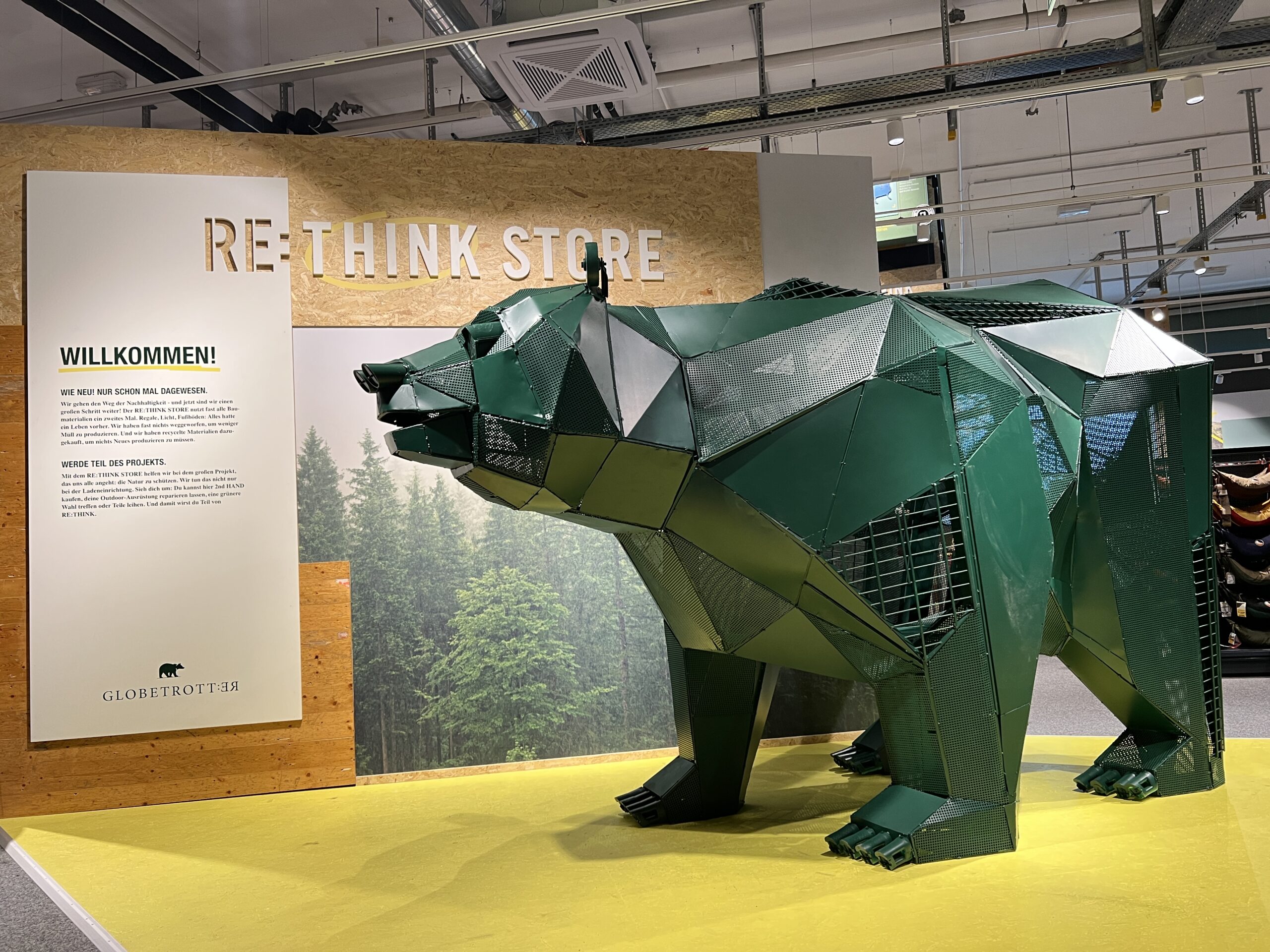
When you enter the Globetrotter Re:Think store on the second floor of a small mall in Bonn, a life-size green bear made of metal immediately catches your eye. The imposing animal from the brand logo symbolizes what the store is all about: circularity. It is made from materials that were left over from the renovation of the store - plates, grids, rolls ... recycling at its best. "A lot of heart and soul went into this project, and it was no easy task to turn a former electronics store into a genuine Globetrotter store," says CEO Andreas Vogler.
Turning old into new - this is the concept behind everything in the Re:Think store. Customers learn about it on graphic walls and information boards. That's a good thing! Otherwise, they would probably not even notice that they are in a store that has also committed itself to the cradle-to-cradle principle in its store design.
All the furniture in the 2,150 square meter Re:Think store comes either from the stock of other Globetrotter locations or from the warehouses of the brands represented. Even the changing rooms are made from old advertising banners and curtains. In total, around 94% of the materials used in the store are re-used. Backpacks now hang from the perforated walls where vacuum cleaners used to hang. The concept also focuses on sustainability when it comes to services: Customers can purchase new and used items, and a rental service is being planned. There is a buying station for second-hand goods and items can be repaired or customized in the workshop.
Globetrotter's showcase project in terms of the circular economy is impressive - and is currently winning one award after another: Red Dot Design Award in the "Brands & Communication Design" category, 1st place in the Best Retail Cases Award and now the German Sustainability Award 2023 in the sports retail category. The success is also due to the fact that the German branch of the Fenix Outdoor retail group thought through the concept down to the last detail and provided scientific support.
"One of the most sustainable approaches is to use things that are already there. It takes courage and a pioneering spirit to go down this path. But the results of the scientific study by our partner EPEA show that it's worth it." - Andreas Vogler, CEO Globetrotter
"It's not enough if we destroy the environment a little less. We have to learn to be useful for this planet," Professor Michael Braungart tells the audience at a lecture in the "Clubhütte" of the Bonn Re:Think Store. "We are the only living being that makes waste. Why are we dumber than everyone else?" The chemist and process engineer is co-inventor of the cradle-to-cradle principle. His Environmental Protection Encouragement Agency (EPEA) has evaluated the conversion and developed a "Circularity Passport Interiors" (CPI) from the results. This describes exactly which products and materials are used and how big their CO₂ impact is. "This will make it possible to compare and optimize different interior design approaches in terms of their ecological footprint in the future," says Markus Diem, Managing Director of EPEA. "This helps to save resources and avoid waste."
According to EPEA's calculations, a conventional shopfitting project of a comparable size would have generated around 105 tons of CO₂ equivalents (CO2e). The re-use concept, on the other hand, only emitted 3.12 tons of CO₂e. This corresponds to a saving of around 97%, which is roughly the amount of CO₂ that would be produced if the earth were to be circumnavigated by car around a dozen times.
As a retailer, it's not very often that you move a store into a former electronics store. And in the production and delivery process of a product, only three percent of CO₂ emissions are caused by the retailer itself. Nevertheless, it is important for the industry to reduce CO₂ emissions wherever possible. The good news first: awareness of the problem is there, and the major players in the sports and outdoor industry are now taking a consistent and structured approach to sustainability. Most retailers are focusing on the three "r's": re-use, repair, recycle.
Sport Conrad, a finalist in the German Sustainability Award 2023 together with Globetrotter and Bergzeit, has embarked on the "Sport Conrad Mountain Path". This sustainability roadmap aims to reduce the carbon footprint by 70% (Scope 1 and 2) and 50% (Scope 3) by the end of 2030 compared to the base year 2019. The measures: Reduce green electricity consumption, packaging materials and print jobs, avoid waste, return resources to the cycle, modernize locations according to environmental protection criteria and generate our own electricity via PV systems. At the same time, Sport Conrad is putting pressure on manufacturers to increase the recyclability of their products. There have already been a few pilot projects, such as "Recycle Your Boots" by Tecnica, "Goggle Recycling" by Scott and "Ski Skin Upcycling" by Doghammer. Recycling projects are also underway with Scarpa shoes and Schwalbe inner tubes.
Bergzeit has developed a sustainability strategy based on three areas of action (Save, Turn, Spread) and pursues as holistic an approach as possible: The first pillar focuses on resource consumption, the second on the circular economy and the third on customer consumption behaviour. Save: Since 2019, the Bergzeit locations have been using 100% green electricity, and since 2021 the retailer has also been producing it itself using its own photovoltaic system. This saves the company around 220 tons of CO₂ per year, taking into account the German electricity mix. Since 2023, Bergzeit has even been offering its own green electricity tariff together with the electricity supplier Energiewerke Schönau (EWS). Turn: The online second-hand store for outdoor clothing, shoes and hardware is being further expanded. Spread: The MUT (People/Environment/Animal) strategy provides customers with seals that they can use to filter products in terms of social, environmental and animal welfare characteristics.
At Intersport, the eco-strategy is called "Best in Sports: Up for Future". It covers the five fields of action of people, product range, environment, retailer and customer. Product design, quality and durability of products paired with more and more repair options are possible levers for increasingly closing cycles. By 2030, all Intersport retailers should also have implemented the minimum standard of a sustainability POS concept. The focus here is on CO₂ savings and the expansion of renewable energies, for example through PV systems, as well as the promotion of the circular economy in the product range. "The ecological footprint of a company is increasingly influencing the purchasing behaviour of consumers. But it is also about showing our members and employees how to act sustainably. After all, sustainability means future viability," says Thomas Storck, CFO and Deputy Chairman of Intersport Deutschland eG.
Sport 2000's roadmap covers the topics of "product and supply chain", "culture and mindset", "location" and "reporting". Sport 2000 International is working closely with Sport 2000 GmbH, the 5-country organization from Germany, Switzerland and Benelux, to implement the roadmap. "With employees from Sport 2000 GmbH and Sport 2000 International, a team - the Green Vision Team - has been formed that works hand in hand to achieve the defined goals," says Véronique Dell. In Germany, Sport 2000 stores receive professional climate advice. The analysis is used to check energy consumption and develop measures to use energy more efficiently. "This allows us to save resources and reduce costs at the same time," explains the Project Manager. The environmental team at Sport 2000 Austria regularly works on optimizing energy consumption, separating waste and raising awareness among employees at headquarters. Sport 2000 France uses the "Objectif Tribu" project to inform customers about the circular economy in the textile sector. Customers can hand in old shoes and textiles and receive a discount on their next purchase.
Sustainability has also long been part of Sportscheck's corporate strategy. The focus of the circular economy is currently on reuse and second-hand. In cooperation with reverse.supply, Sportscheck is using a new circular store to test how reuse is received by customers. And a recycling system is being set up with partner I:CO, one of Europe's largest recyclers.
Yonderland 's five-year plan focuses on the promotion of sustainable, recyclable outdoor products, CO2 neutrality, waste avoidance and the protection of regional open spaces through project work and donations. The retail group's sustainability activities have already received several awards. Among others, the Dutch chain Bever received the "Sustainable Retailer of the Year 2022-2023" award. Bever was praised for its commitment to promoting the circular economy along the entire value chain. The jury also examined the sustainability strategy and was impressed by the care and repair services.
Decathlon is focusing on renewable energies, particularly in its home market of France, and is gradually installing PV systems on its stores. By 2026, the company aims to reduce its direct and indirect greenhouse gas emissions by 40% compared to 2016. By participating in the EU Green Consumption Pledge initiative, Decathlon is also committed to helping customers make more sustainable purchases. In order to make the targets and performance indicators for sustainable development in the three areas of people, planet and profit measurable and achievable by 2026, these are set out in a globally applicable transition plan that applies worldwide.
Ultimately, it is now up to the retailers to ensure that their plans do not degenerate into lip service. And, of course, on the customers, who have to accept the sensible offers. Globetrotter CEO Andreas Vogler is also convinced of this: "Sustainability requires transparency and participation. We have a valuable resource at our disposal: direct access to millions of customers, with whom we also communicate on the topic of sustainability. With the right offers, we can make it easier for our customers to act sustainably."

Green deal, proposal to ban PFAS and PFCs, push towards recyclable materials and more sustainability: innovations are being worked on diligently to get the chemistry right again. Harmful materials in the outdoor industry are to be replaced as quickly as possible. The following overview shows the developments in fiber research in performance clothing that are leading to greater sustainability.
PFCs or PFAS, i.e. perfluorinated or polyfluorinated alkyl substances, were long considered the perfect match for outdoor clothing thanks to their outstanding water and dirt-repellent properties: In DWRs (Durable Water Repellency), i.e. coated impregnation, but also in the manufacture of membranes, which are often used in waterproof clothing. The problem is that these "forever chemicals" do not decompose in conventional processes in nature. Instead, they accumulate, even in ever-increasing quantities. And everywhere: the chemicals have been detected in polar ice, in food and even in human blood. Their harmful effects on health are also well known. There has been a political response at European level with a proposal to ban PFAS, thus initiating a more active search for solutions in the industry. "There have long been substitutes, especially for consumer products such as textiles or packaging, and a ban is long overdue. For special applications, good alternatives must first be developed - but in my view, the proposal allows enough time for this," says Prof. Dr. Henner Hollert, Professor of Evolutionary Ecology and Environmental Toxicology at the Johann Wolfgang Goethe University in Frankfurt am Main.
Although it has been in the works for a while, the PFAS phase-out for outdoor brands is complex due to the performance demands placed on the products. Functionality and practicality are weighed against the environmental impact. Pioneers like Vaude and Fjallräven have been relying on PFAS-free impregnation and membranes for around a decade and voluntarily converted their collections step by step. But the search for alternatives was not easy. Especially for components such as zippers was more complicated than expected, as there were no waterproof alternatives on the market.
Other product and component manufacturers are following suit, but the solution has not yet been found. According to a Globetrotter study most of the brands surveyed now expect to have banned PFAS from their products by 2027.
Cleaner and greener: sustainability in the textile industry
There are various approaches to using more sustainable alternatives. More and more brands are using PFC-free alternatives in the production of their clothing - such as the materials and membranes from Polartec or Sympatex. In some cases, recycled polyester or polyamide and thinner materials are also used, which in turn reduces CO₂ emissions. Membranes such as Futurelight or Dermizax are also taking this approach.
Another development approach is moving towards bio-based materials. This includes, for example Biolona plant-based nylon fabric that Polartec plans to gradually replace petroleum-based products in fabrics and membranes from 2023. Also Modern Meadow also relies on biomass in the production of its waterproof and breathable Bio-Tex Shield membrane technology. Because the material is particularly abrasion-resistant, two-layer use can also save material compared to a three-layer construction, thus reducing the carbon footprint. Vaude and UPM are working together to produce outerwear made from biomass. In the world's first biorefinery, which is due to go into operation at the end of 2023, it should also be possible to produce fabrics for membrane production in the future.
How do we design a circular future with natural materials?
Gore-Tex, which is often used synonymously with waterproof clothing, has also launched a new, more sustainable ePE membrane. Compared to previous products, it can be made thinner and therefore requires less material, saving carbon dioxide during production. The company has been working on this for around ten years with brand partners such as Patagonia and also uses recycled polyester in the manufacturing process.
The expanded polyethylene (ePE) material platform is produced similarly to PTFE (polytetrafluoroethylene) membranes, for which Gore is known. However, it does not use PFAS in the membrane and impregnation. "The great thing about it is that it performs just as well," says Lara Wittmann, Global Strategic Marketer at W.L. Gore & Associates. However, development is already continuing and, according to Wittmann, a more sustainable version of the Gore-Tex Pro membrane, the ingredient brand's best-performing product, is set to follow in two years' time.
Merino wool: advantages & benefits of the sustainable fabric
Of course, the move towards PFAS-free materials is a good and correct one. In the medium to long term, however, it is just as important that a jacket can be recycled at the end of its life. However, the combination of three different materials, such as in a three-layer jacket, makes recycling difficult or even impossible. Instead of being reused or recycled, this often means: off to the bin!
So it's all the better that brands such as Jack Wolfskin and Mammut are in the process of using mono-materials for the membrane, outer layer and base layer, making waterproof clothing recyclable. In 2024, various collections, for example made from 100% polyester, will be launched on the market that are both made from recycled material and can be recycled again.
Would it now be best for us as consumers to switch directly to a new, more sustainable membrane, i.e. to buy a new waterproof jacket? Experts clearly say no. This is because the harmful release of PFAS is primarily an issue during production and disposal. The most sustainable product is therefore still the one you already have. It causes neither newly released CO₂ during production nor other harmful emissions.
5 facts why wool makes functional clothing better
That's why it also makes sense to look after the products properly or repair them so that they can be worn for as long as possible. In the case of Gore-Tex products, for example, this means that they must be washed regularly and the membrane cleaned in order to remain functional. After washing and drying, the garment should be heat-treated again, either in the tumble dryer or by ironing with a towel in between, so that the membrane's permanent water-repellent properties are reactivated.
At the same time, the intended use of the garment also plays an important role, which we should all critically reconsider when we need something new. Does the membrane really have to be oil-repellent? Do we only wear the three-layer jacket to walk the dog or to climb the next four-thousander? Accordingly, we should decide whether there is no alternative to the PTFE performance membrane, or whether a natural or at least more sustainable version might also offer the desired performance and keep us dry when walking the dog.
17 brands that offer repair services
Hiking with children - testing the THULE SAPLING child carrier

The sports and outdoor industry is currently facing economic challenges. At the same time, it needs to become more sustainable. After all, customers want to continue to enjoy an intact environment. How can this balancing act be achieved?
In short: the industry needs new KPIs alongside the traditional ones. We have already dealt with this in the first part on outdoor sourcing KPIs.
But the challenges are not just internal to the industry. They affect each and every one of us and the entire economic system. Necessary changes affect sourcing, eco-design, purchasing, production, sales and end-of-life management. The use of chemicals, CO2 emissions and water management must be subordinated to the protection of biodiversity.
Too abstract? Let's consider the following figure: the European Parliament estimates that textile production - especially fast fashion - is responsible for a whopping 20 percent of global environmental pollution.
If biodiversity is to be preserved, it is best to use scientific studies as a basis for strategies, innovations and solutions. They also form the basis for French and European regulations on sustainability, monitoring and transparency. All this is to enforce proper due diligence.
"To combat the negative impact of this phenomenon on the environment, the EU wants to reduce textile waste and increase the life cycle and recycling of textiles. This is part of the plan to achieve a circular economy by 2050." Source: European Parliament, June 2023.
The control of resource management, due diligence, ESG reporting - everything is pushing for more efficiency and transparency so that the impact remains as low as possible.
Greenhouse gases, the water cycle and plastic pollution have the greatest impact on the environment. This affects both the preservation of biodiversity and the health of humans, who can be exposed to more or less hazardous chemicals through their consumption decisions. However, by focusing on the efficient use of resources, the sustainability of products and waste management can be significantly improved.
Some brands have anticipated this global approach, such as Oxbow™, Rip Curl™ or Salomon™. The latter, for example, measure the footprint of their company headquarters in Annecy every year. Others have calculated the footprint of a product as part of a life cycle analysis, such as the INDEX shoe series from Salomon™ or the Standard Expedition Parka from Canada Goose.
Control is achieved through awareness-raising covered by senior management, science integrated into production systems, and traceability and AI tools, of which a responsible and sober performance indicator is an integral part.
"If we can use AI to validate data, highlight inconsistencies and potentially close gaps, CSR managers could focus on working with their partners to optimize the supply chain. By getting involved, they can create real value and make a positive impact." Philipp Mayer, Cofounder of Retraced
The Corporate Sustainability Reporting Directive (CSRD) is a European directive that aims to strengthen and harmonize the disclosure of non-financial information by large companies. It aims to provide a transparent, robust and cost-effective framework for the provision of information, particularly in relation to reporting standards and external data verification.
With this in mind, procurement and purchasing must adhere to twelve overarching and thematic standards, of which performance measurement is an integral part. The most advanced traceability tools are the brands' best allies. They are designed to make the invisible visible by helping to find, manage, verify and secure supplier data at a high level.
In a reverse supply chain process, traceability functions could track and manage waste and fibres, enabling a transparent and comprehensive circular economy. In addition to assessing the business model, the main task of non-financial ESG reports is to present environmental, social and governance aspects in a matrix to determine their role in assessing risks and returns.
A material analysis has already been published on the Decathlon Group website, comparing the brand's requirements with those identified and defined by stakeholders. This work to track risk management and challenges to secure provenance and ownership through collaboration and partnership will be key to adaptation.
"Through the use of technology, Decathlon is following the latest best practices recommended by the European Financial Reporting Advisory Group (EFRAG), the organization responsible for setting the future European reporting standards for sustainability development." Donato Calace, member of the EFRAG working group of CSRD experts
Short procurement channels: What can local sourcing do?
According to this year's the regeneration rising report by creative agency Wundermann Thompson, 83% of respondents from the UK, US and China believe that companies and brands should focus more on making a positive impact rather than causing harm to the planet and its inhabitants.
But how can this management be achieved? And what does this positive approach mean? This is the fine line between paradigm shift, project management and greenwashing. Brands commit to "carbon neutrality" - a claim that will soon be banned in France - and they have to prove it in order to comply with certain regulations or sell their products in certain territories.
For example, Haglof™ is committed to making products more durable and exploring alternative business models. All Birds™ claims to be launching the first net-zero carbon shoe. Certifications and standards such as bluesign® or the Global Organic Textile Standard (GOTS) also promote more sustainable and responsible practices in the textile industry to reduce the impact on water and the environment. Carbon credit schemes are used to reduce carbon emissions. All of these initiatives will be positive if they help make a difference between offsetting, capturing, reducing and restricting.
"90 percent of biodiversity loss is due to the extraction and processing of natural resources, and many of the most effective solutions involve new ways of producing, consuming and handling materials in a circular economy." Source: the nordic innovation
According to the organization CEC (Convention des entreprises pour le climat), the regenerative economy consists of business models that go beyond impact reduction or even the goal of "net zero". They aim to regenerate entire ecosystems by relying on new and expanded forms of collaboration between actors in a given territory.
Regenerative fashion is a concept that is emerging in the fashion industry and is based on a holistic approach that aims to repair and revitalize natural and social systems. It focuses on the impact on the environment and communities along the entire life cycle of garments, from design and production to use and disposal. These principles are the same as for regenerative agriculture.
The challenges and impacts of this system relate to ecological design, transparency and the restoration of ecosystems. It aims to transform the fashion industry into a positive driver of change by fostering creativity and innovation and creating closer connections between consumers, designers and communities.
Nevertheless, regenerative concepts should be treated with caution in sourcing and production. This is because to achieve their goals, strong, verifiable commitments to impact reduction and production must be imposed, including clear measures in favour of biodiversity. This very committed system is of particular interest to per se sustainable brands such as Picture Organic™ or brands capable of profound change, such as Fusalp™, both of which are involved in the CEC Alpes program. This is also the direction that the Swedish brand Haglofs™ seems to be pursuing.
Dangerous microfibers - How can the outdoor industry stop the flood of plastic?
Although water directly affects planetary boundaries with the acidification of the oceans, the freshwater cycle and the balance of the biosphere, which also contains water vapour, it receives little attention.
According to UNESCO, water has multiple values and benefits. But unlike most other resources, it is extremely difficult to determine its "real" value. This concerns its use in production processes as well as pollution and waste.
According to the international organization Fashion Revolution™, in the worst-case scenarios, only 80% of the dyes remain on the garment, while the remaining 20% are released during rinsing. Every year, no less than 40,000 to 50,000 tons of dye are released into rivers. This waste contains heavy metals and perfluorinated compounds (PFCs), which are used to increase colour depth as well as non-iron and waterproof properties.
Perfluorooctanoic acid (PFOA) has been banned in Norway for several years. Nevertheless, chemicals are indispensable in the textile industry. Fortunately, there are circular pigments such as Dye Recycle™. Approaches for mineral, microbial or bio-based pigments, and PFC-free solutions are available from Goretex™ or Singtex™.
"The next big health scandal will be about the toxicity of garments." Audrey Millet, historian and researcher in the textile industry, in the book "Noir de la mode."
According to ADEME, the equivalent of 50 billion plastic bottles are thrown into the sea every year. Most of these end up as tiny pieces of waste known as "mermaid tears". The outdoor and sports industry contributes directly to these problems as polyester, a petroleum-derived material, is the most widely used textile material in the world.
There is an urgent need to address this challenge in the outdoor products sector. How can we address the risks associated with the use of these resources and the practice of outdoor sports? The Vaude brand is working with UPM Biochemicals to find a solution for outdoor apparel made with bio-based chemicals.
"The fashion industry currently accounts for about 20% of global industrial wastewater and 8% of global greenhouse gas emissions." Source: United Nations
To define performance with restraint, leadership and systematic criteria, harmonization of global supply chain management is necessary. This would allow the OutDoor industry to move forward into a stable and sustainable system, with more accurate data, less waste and overproduction. This industry belongs to all of us, and together we should ensure that digital and responsible know-how becomes the norm.
There is no perfect product or process, but together brands, consultants, yarn manufacturers and fabric suppliers can create a more transparent, efficient and sustainable sourcing process. A more sustainable supply chain is about performance and requires collaboration between different areas such as sourcing, purchasing, finance, marketing, logistics, supply and many more.
It is up to all of us to make our contribution. And new ideas are more than welcome.
The future of retail: How cradle-to-cradle works in stationary retail

With take-back services, brands and retailers want to give consumers the good feeling that their used clothing is getting a second life. Sometimes this works, but often the favourite pieces end up in landfills or are incinerated. The answer? Textile-to-Textile (T2T). We explain how it works and who demonstrates it.
At present, many brands are relying on take-back services. The used clothing is usually picked up by partner companies, sorted, resold - or ends up in the rubbish or in the incinerator. This is because a large proportion of the clothing that is currently intended for reuse through take-back systems is not suitable for the second-hand market.
Recycle, reuse, resell, repair - we already know all that. But what about a completely new life? Completely transforming a product at the end of its life cycle into a raw material for a new substance? It's possible! The principle is called Textile-to-Textile (T2T). This would close the cycle of a garment - perhaps the start of the circular economy becoming mainstream.
Award-winning circular innovation companies Spinnova and Renewcell are taking a first step in this direction. They have announced their collaboration on the launch of a technology concept to scale the production of next-generation textile fibres from textile waste. The new fibre production concept combines patented technologies from both companies and takes the circular economy in the fashion and textile industry a step further.
Pioneering a circular economy in the fashion industry, Renewcell recycles cellulose-rich textile waste such as cotton and viscose using a patented process that transforms textile waste into a pulp product called Circulose. This biodegradable raw material is made from 100% recycled textiles and can be used to make new fibres.
"The textile industry is in the midst of a massive shift from a linear business model to a circular economy. The change requires new partnerships and bold, innovative actors*. It was really exciting to learn more about Spinnova's technology. We can't wait to launch the first Circulose collection made with Spinnova's unique fibre spinning technology," says Patrik Lundström, CEO of Renewcell.
Until now, circulose has been used to produce man-made cellulose fibres, such as viscose. With Spinnova's transformative technology, the partners can convert Circulose into a new, bio-based textile fibre that does not require harmful chemicals in the fibre spinning process. This is a remarkable step toward solving the industry's growing textile waste problem, while setting new standards for sustainable textile fibre production.
Spinnova has already made several successful attempts to spin the Circulose pulp into new textile fibres. The first batches of Spinnova fibers made from 100% Circulose have been used to develop yarns and fabrics, and the first prototypes are made from a blend of cotton and Circulose.
The trend toward man-made cellulose fibres in sports is definitely one to keep an eye on.
"The fashion and textile industry needs new solutions and collaboration across the supply chain, which is what makes this partnership so exciting for us. Our goal is to accelerate the fashion industry's transition to a circular economy and explore ways to scale production from textiles to textile fibres", says Ben Selby, deputy CEO of Spinnova. He reports that initial tests combining Renewcell's material and Spinnova's technology have been very promising.
The companies are currently exploring with potential partners ways to scale textile-to-textile fibre production and expect to begin developing the first commercial collection of Circulose fibres soon. Consumers are expected to be able to buy the first products by the end of 2024.
Other brands are also making inroads. The Walmart Foundation has committed $1.2 million to support Goodwill Industries International Inc. and Accelerating Circularity.
Goodwill is a U.S. non-profit that sells donated clothing to support local projects. Because it is a charity, the amount and variety of clothing dropped off is unique compared to other retailers. Viscose, cotton, synthetic fibres, blends - they can all be given a new life with Accelerating Circularity.
Skills, systems and infrastructure will be built at participating Goodwill organizations to turn unsaleable textile donations into recycled materials. This transformation is critical to the circular economy in textiles.
"Goodwill is focused on developing solutions for textiles that are scalable, circular and traceable. We see textile-to-textile recycling as an important pathway for clothing donations that are no longer useful and have reached their end of life," says Brittany Dickinson, director of sustainability at Goodwill Industries International.
Accelerating Circularity's (ACP) mission is to develop new supply chains and business models to turn end-of-life textiles into common raw materials. ACP is a non-profit organization focused on textile-to-textile recycling at commercial scale. To do this, the action-oriented NGO relies on a collaborative approach led by its various stakeholders.
They have the expertise, but in the end it's brands and retailers that need to take charge. That will be done through collaboration, which will also be funded by a grant from the retail sector.
"We want to advance our mission by helping Goodwill turn textiles destined for recycling into higher-value recycled raw materials. We sort to specifications, remove trims and other interfering materials, and collect sufficient quantities to support full commercialization of textile-to-textile systems," says Karla Magruder, president and founder of Accelerating Circularity.