

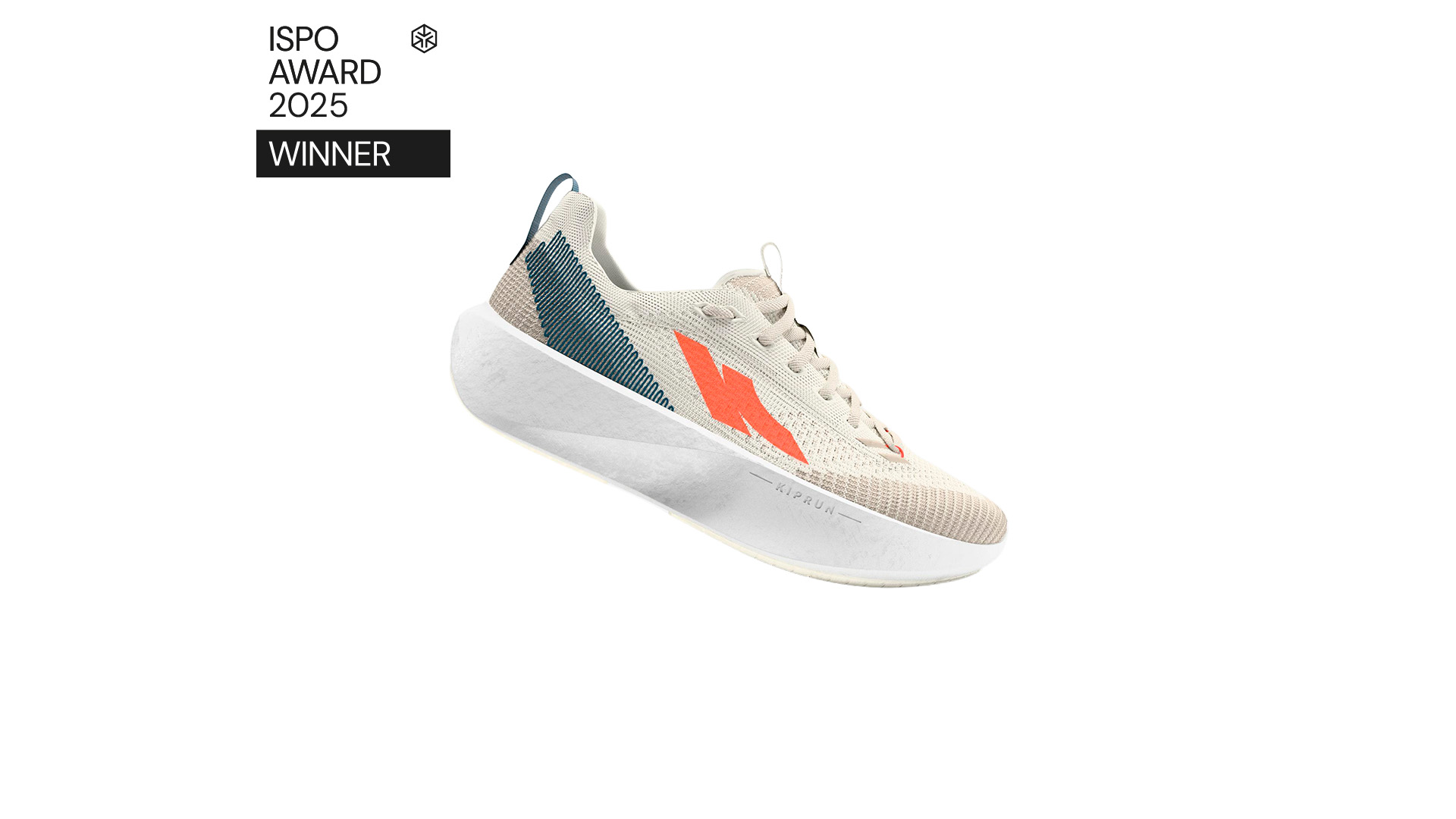
Kipnext reduces manufacturing steps from 15 to 1, eliminates glue, cuts CO₂ impact and delivers full-performance cushioning — earning an ISPO Award 2025.
Innovation in running footwear often comes from incremental improvements. Kiprun’s Kipnext (KIPX) takes a radically different path. Awarded an ISPO Award 2025, the shoe is built through a completely redesigned process that reduces traditional soling and assembly steps from 15 to just 1. Using a patented manufacturing method, the midsole, outsole and bonding to the upper are created without any glue or chemical adhesives, removing a major environmental burden from the production chain.
“Winning the ISPO Award is an immense recognition for us. After four years of intense R&D, industrial partnerships and iterations, this prize validates both our technical achievements and our environmental ambitions,” says Stéphane Benaddi, Technical Project Leader Footwear Process. For Kiprun, the award underscores a commitment to prove that performance and sustainability do not need to be competing goals. Kipnext shows how a bold production shift can deliver both.
At the core of Kipnext lies a process innovation that challenges long-established industry routines. Instead of producing midsole, outsole and upper separately, then bonding them through multiple adhesive layers, Kiprun uses a supercritical fluid foam injection process. Nitrogen is mixed under high pressure with a thermoplastic compound, which forms and binds the sole unit in a single step around the upper.
“One major challenge was to rethink the shoe manufacturing process from the ground up,” explains Pacôme Tomietto, Material Engineer Footwear Process. Traditional running shoes rely on complex component stacks, manual bonding and chemicals such as azodicarbonamide or solvent-based glues. Kipnext removes these entirely — simplifying the overall product structure, cutting chemical use and lowering the environmental footprint.
The result: a 26% reduction in CO₂ impact (PEF methodology) through fewer components and reduced energy usage. At the same time, the new sole materials improve end-of-life recyclability, giving the product a clearer route into future circular systems. Despite this radically simplified construction, Kipnext maintains the cushioning, durability and lightness expected from a performance running shoe.
Glue-free construction alone would not be enough to convince serious runners — so Kiprun backed the concept with extensive testing. Kipnext underwent abrasion, flex and impact cycles across long-distance simulations. According to the brand’s internal testing, the shoe is 50% more durable than comparable Kiprun models using traditional foam bonding after 1,000 km of use.
For retailers, Kipnext offers a clear and compelling proposition: a shoe that significantly lowers production impact while meeting the performance expectations of the running community. The concept aligns with a growing consumer segment looking for products that combine technical credibility with responsible manufacturing.
“For Decathlon stores, Kipnext’s unique selling point is its status as the world’s first glue-free performance running shoe displaying a proven reduction in environmental impact,” says Romain Degezelle, Kiprun Footwear Product Manager. It gives stores a tangible, science-backed story that resonates with eco-conscious athletes.
With Kipnext, Kiprun presents more than a single product – it introduces a new industrial platform. The technology behind the model is designed to scale, opening potential pathways for use across other categories and silhouettes. Reduced production steps, fewer chemicals, lower emissions and improved recyclability form a blueprint that could influence how performance footwear is built in the coming years. “This award will also help us to pursue new similar projects and look to the future – on how we can incorporate new technologies, to enable the best types of footwear for our consumer,” notes Degezelle.
The ISPO Award 2025 recognizes exactly that momentum: a manufacturing breakthrough with the potential to reshape industry standards. Kipnext embodies a forward-looking approach where less complexity, fewer materials and smarter processes support both performance and environmental responsibility.
"The Kiprun Kipnext stood out to the ISPO Award jury for its radical new manufacturing approach. By reducing soling and assembly steps from 15 to 1 and completely eliminating glue and chemical adhesives, the shoe significantly lowers environmental impact. Its one-step supercritical foaming process cuts CO₂ emissions by 26% while maintaining the cushioning, durability and lightness expected from performance running footwear." ISPO Award Jury

Kleinwalsertal is leaning into alpine diversity, a clear strategic direction, and a long-term plan designed to strengthen all four seasons. With versatile summer and winter offerings and a culinary culture that thrives year-round, the destination preserves its roots while confidently shaping its future.
Kleinwalsertal now positions itself as a genuine year-round destination. The region continues to rely on a strong winter season, complemented by an active summer and a targeted expansion of spring and autumn—times of year when natural tranquility, clear mountain moments, and culinary experiences are especially compelling. This development is guided by the Tourism Strategy 2034, adopted in 2024, which outlines the destination’s trajectory for the decade ahead.
The strategy focuses on rejuvenating target groups, strengthening experience-based offerings, and modernizing communication through digital channels. The aim is to demonstrate how sports, nature, and regional quality work together across all four seasons. As Justina Rokita, CEO of Kleinwalsertal Tourism, explains:
Wir haben mit der neuen Tourismusstrategie 2034 den Mut gefasst, Bewährtes neu zu denken. Das Kleinwalsertal entwickelt sich konsequent zur Ganzjahresdestination, die alpine Vielfalt, junge Impulse und starke Qualität verbindet. Unser neues Corporate Design steht für diesen Wandel: Revolution statt Evolution und ausgezeichnet als Red Dot Winner 2025. Mit neuen Produkten wie Nordic The Valley und unserer einzigartigen Genusskultur zeigen wir, dass Sport, Natur und Kulinarik im Kleinwalsertal eine besondere Einheit bilden.
A pristine natural environment and a blend of year-round sports, culinary, and relaxation offerings enable experiences that go far beyond traditional seasonal patterns—forming the foundation for the valley’s evolving identity.
Kleinwalsertal’s new corporate design marks a rare and bold step in alpine tourism. After more than two decades, the entire brand was restructured—visually, verbally, and strategically. The result is a clean, reduced, and distinctly digital identity that still maintains a strong connection to the valley. Nature, quality, and a modern visual language form its core.
The Red Dot Award for Brand & Communication Design 2025 underscores this direction and signals a clear commitment: brand development is a central component of the region’s future. The new identity provides orientation and reflects a mindset that is both open and deeply rooted.
The ISPO Award Jury, during its Q3 meeting at the Biohotel Chesa Valisa, gained a firsthand impression of this new trajectory. The combination of a contemporary brand approach, regional character, and direct access to nature and sports underscored how consistently the valley is implementing its strategy.
All ISPO Award Winners at a Glance
Winter remains a central pillar in Kleinwalsertal—economically and in terms of identity. Alpine skiing is the region’s core business, supported by modern infrastructure that includes ski-in/ski-out access, short connections, and a well-coordinated lift system. At the same time, winter hiking has grown significantly and offers a quieter way to experience the landscape.
The valley also maintains a 50-kilometer network for skating and classic cross-country skiing. Complementing this, Nordic The Valley introduces a broader take on winter. Starting in January 2026, the event expands the season with Nordic-focused highlights: the Rookie Classic (7.5 km) and the Walser Classic Hero Challenge (40 km) form the athletic backbone. Developed with a Munich-based performance athlete, the format is supported by modern reels, short videos, and a clear visual identity that makes Nordic sport accessible to both beginners and experienced skiers.
The result is a winter that builds on alpine strengths while adding new layers. The combination of skiing, Nordic offerings, and winter hiking illustrates how the valley is evolving without losing sight of its roots.
Sports shape Kleinwalsertal’s profile, but its identity is equally defined by culinary culture. From the Michelin-starred Kilian Stuba to the Sonnenstüble at Birkenhöhe (3 Gault&Millau toques), and the Oswalda Hus, winner of the Gault&Millau Future Award Vorarlberg 2026, the valley offers an impressive concentration of high-end dining. Many hotels and restaurants follow certified organic standards, working with regional ingredients and a philosophy that blends tradition with contemporary alpine cuisine.
Culinary excellence is closely linked to the surrounding landscape: the Allgäu Alps, three Walser villages, and a cultural heritage dating back to the 13th century. The valley’s unique geography—reachable only via Germany—adds a distinct character: independent, slightly unconventional, and undeniably modern.
With its strategic direction and authentic identity, Kleinwalsertal is well positioned to move confidently into the future.
Event Highlights Kleinwalsertal Winter 25/26: Experience Winter Activities | Kleinwalsertal
Chesa Valisa: The Nature Hotel Chesa Valisa | Kleinwalsertal
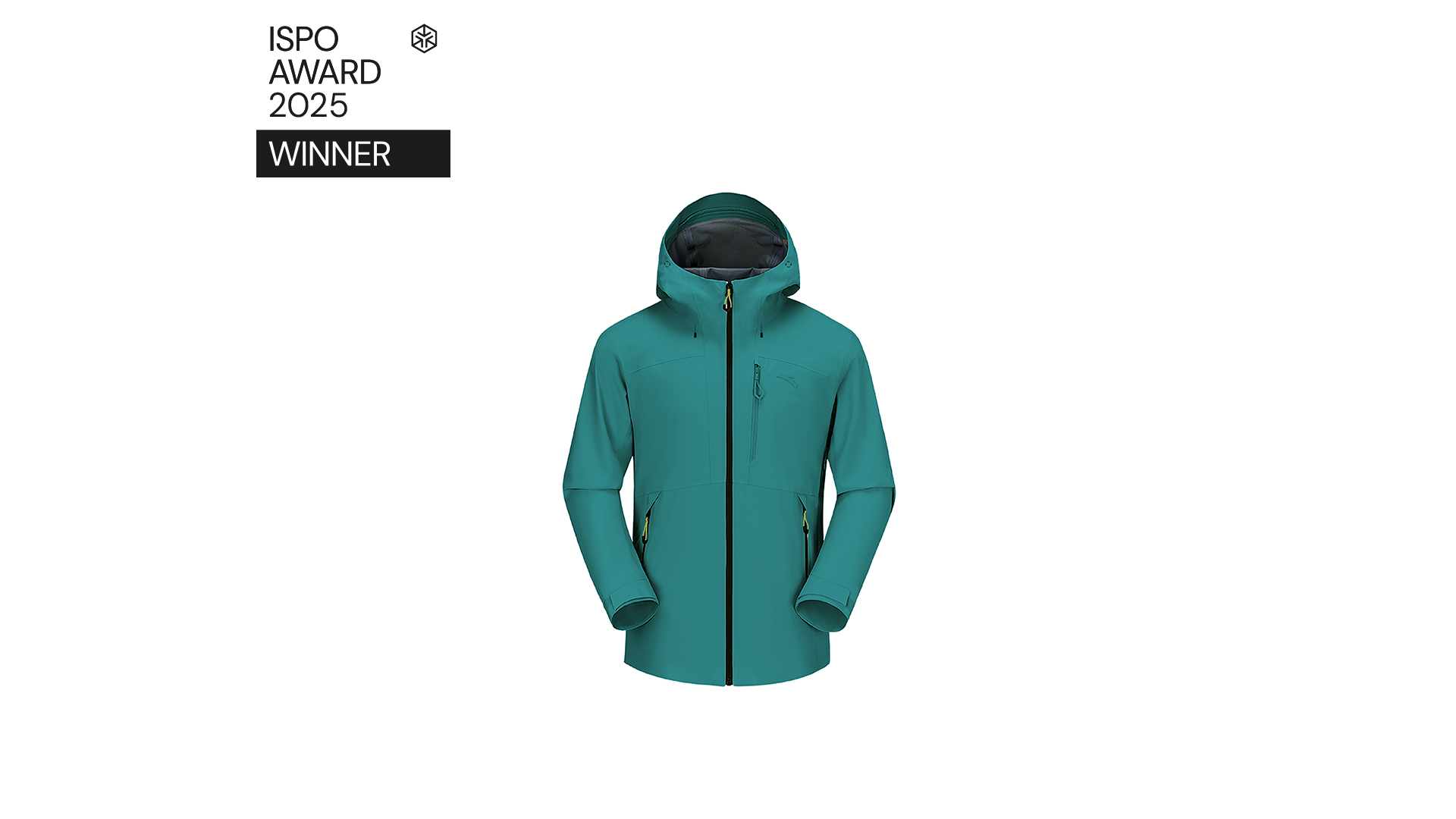
A membrane designed for long-term wash durability and bio-based, PFAS-free materials shapes the circular concept of Anta’s Resibrane Jacket.
With the Resibrane Jacket, Anta introduces a waterproof concept built around performance stability and lower resource waste. At its core is the resibrane membrane, designed to retain more than 95% of its waterproof capability after 30 wash cycles. Typical membranes show significant decline after only five to ten washes, positioning this durability as a measurable contribution to extending garment lifespan. The membrane exceeds a hydrostatic head of 20,000 mm, supporting reliable protection during sustained exposure to wet conditions.
“Being recognized by ISPO validates our team’s ability to create outstanding products, drive meaningful innovation, and deliver real value to consumers,” said a responsible representative of Anta. By stabilizing waterproof performance over time, the jacket reduces the need for frequent replacements, lowering emissions associated with new production.
The material concept of the Resibrane Jacket integrates several pillars of responsible design. The primary fabric uses sorona® bio-based fibers derived from annually renewable plants, reducing reliance on fossil-based synthetics. Anta applies solution dyeing, embedding color directly into the fibers to significantly cut water consumption and emissions. The full construction is PFAS-free, eliminating persistent pollutants often associated with waterproof apparel. Complementary components—including zippers, drawcords, tapes, labels, and embroidery—are made from recycled materials to support end-of-life recovery.
While the supplied documents describe the jacket as part of a closed-loop system, specific procedures for disassembly or feedstock return are not outlined. Nevertheless, the consistent use of bio-based and recycled elements reflects a coherent approach to circularity across the garment’s production chain.
The Resibrane Jacket incorporates movement-centered patterning developed from sports biomechanics research. Its 3d tailoring, underarm gussets, and 135° sleeve pitch support unrestricted reach during hiking, commuting, or travel. The articulated shoulder–sleeve construction reduces resistance when climbing or navigating uneven terrain. An updated napoleon chest pocket remains accessible when wearing a backpack or harness and helps protect electronic devices by using body heat to slow battery drain in cold conditions.
Safety and adjustability are enhanced through an integrated recco rescue reflector and the cohaesive multi-axis cord system, which allows precise hood and hem adjustments in variable weather. The design language emphasizes clarity and utility, with clean paneling and minimal visual distraction.
The Resibrane Jacket reflects Anta’s intention to merge durable waterproof performance with lower-impact materials and manufacturing. From sorona® bio-based fibers to solution-dyed fabrics and PFAS-free chemistry, each component contributes to a more responsible product lifecycle. For retailers, the jacket offers measurable durability credentials and a clearly defined sustainability narrative. For consumers, it combines dependable weather protection with materials chosen for long-term use and reduced environmental burden. The ISPO Award 2025 recognizes the jacket’s ability to integrate lasting performance, responsible material sourcing, and functional patterning into a coherent technical shell.
"The jury recognized the Resibrane Jacket for its long-lasting membrane performance, use of bio-based fibers, and reduced-water solution dyeing. By combining a durable waterproof system with sorona materials, recycled trims, and PFAS-free construction, Anta delivers a technical shell with a clear step toward circularity." ISPO Award Jury
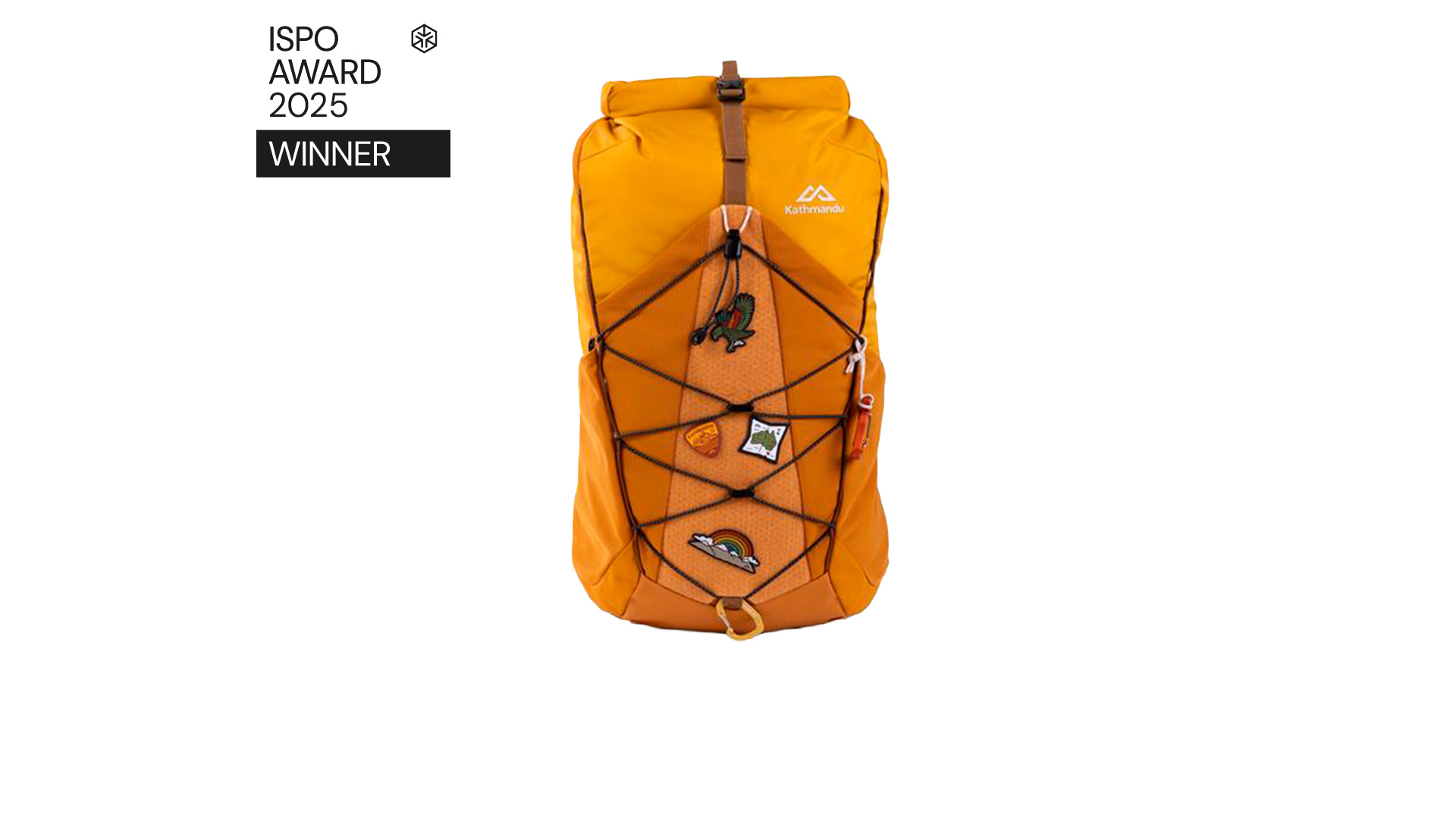
Kathmandu’s Trailhead Pack combines modular design, recycled materials, and creative self-expression — earning an ISPO Award 2025.
With the Trailhead Pack, Kathmandu challenges conventions in outdoor gear. Recognized with an ISPO Award 2025, the backpack merges technical innovation, sustainability, and a deeply human idea: self-expression. Designed in Ōtautahi Christchurch, the pack redefines the link between performance and personality. Its most distinctive feature is the badge zone — a seamlessly integrated badge panel that looks stitched on yet allows endless rearrangement. As the Kathmandu design team explains, “This first integrated badge panel in hiking gear: not just an add-on but seamlessly built into the pack. The badges attach to look like they’ve been stitched on yet can be rearranged endlessly to reflect your story and your latest adventure.”
The result is gear that tells a story, not just carries one. Every detail, from ergonomic shaping to soft-touch materials and clean daisy-chain lines, has been designed to feel complete — with or without customization.
Adaptability defines the Trailhead’s design. From city commutes to day hikes and ultralight overnights, it evolves with its user. Modular cords, pouches, and carabiners can be attached along carefully placed daisy-chains in over three million configurations. A dual-access roll-top closure and stowable hip belt make it easy to switch between urban and outdoor modes.
At just 900 grams, the pack is crafted from 100 percent recycled nylon, free of added PFAS. Breathable mesh panels add comfort, while the durable structure and modular system support longevity.
As a certified B Corp, Kathmandu integrates environmental and ethical responsibility throughout its production process. The badge panel uses a cleaner alternative to neoprene with non-toxic, solvent-free adhesives, and the packaging is biodegradable or recyclable. These elements show how sustainability is not treated as an afterthought but built into every stage of the design.
The Trailhead Pack goes beyond function — it celebrates individuality. The badge zone’s soft-touch, three-layer bonded stretch fabric makes personalization intuitive and risk-free. According to the Kathmandu design team, “The badge zone makes personalisation intuitive: badges attach as if stitched or adhered, but without any skills required and without risk of damage.”
Users can adapt their pack to a mood, a journey, or a life stage, even swapping patches with friends. For consumers, it’s a product that reflects who they are. For retailers, it’s a dynamic platform for engagement and repeat sales — each badge or accessory extending the story.
“The Trailhead Pack combines performance with personal storytelling,” the Kathmandu team adds. “Its integrated badge zone and modular accessories turn the pack into a customisable canvas, allowing users to express their identity while staying adventure-ready.”
Even without personalization, the pack remains balanced, stylish, and ready for any setting — a reflection of inclusive, adaptable design thinking.
For Kathmandu, the ISPO Award 2025 acknowledges both innovation and intent. “Winning this ISPO award is a credit to our design team in Ōtautahi Christchurch. It recognises the creativity and care that went into every detail, from the way the pack moves with you to the ways you can make it your own. And we can't wait to share how this product will keep evolving,” says Megan Welch, CEO of Kathmandu.
The Trailhead Pack embodies the evolution of modern outdoor design: a blend of adaptive function, sustainable craftsmanship, and personal storytelling. It’s not just equipment — it’s a companion that grows with every journey.
"The Kathmandu Trailhead Pack convinced the ISPO Award jury with its combination of modular design, sustainable materials, and authentic self-expression. The integrated badge zone introduces a new way to personalise outdoor gear, while its recycled, the free of added PFAS construction underscores a strong commitment to responsible innovation." ISPO Award Jury

A paramedic-designed kit that offers organized, lightweight emergency care with offline guidance for remote hiking conditions.
The Hiking First Aid Kit from Survival Aid rethinks emergency readiness for hikers by combining structured organization with high-quality components curated by medical professionals. Designed for remote environments where every decision carries greater weight, the kit uses labels and color-coded sections to guide rapid access during stressful situations. This approach reflects how paramedics categorize, prioritize and sequence care. Its compact form attaches easily to a belt or carabiner, supporting mobility on long ascents or technical trails. “We are honored to receive this ISPO award. It recognizes our commitment to making first aid simple, accessible and effective for every outdoor adventurer,” said Marit Onrust, Managing Director, Survival Aid. From minor cuts to more severe injuries, the kit provides a clear workflow that helps users stay oriented even when acting under pressure.
At the core of the kit’s effectiveness is its structured interior. Each section is labeled for intuitive navigation, reducing the time spent searching for the correct item during an incident. The selection of medical components—including a splint for fractures, a smart bandage for snake bites and severe bleeds, as well as materials for sprains, burns, scrapes and minor wounds—reflects the realities of backcountry travel.
The iFirstAid app extends this logic by offering step-by-step instructions that remain accessible even offline. By combining physical tools with digital guidance, the system bridges knowledge gaps for less experienced hikers facing unfamiliar scenarios. The materials are chosen for durability and reliability, ensuring that the kit withstands repeated travel, changes in weather and long-term storage without compromising function.
The kit is tailored for hikers exploring areas where immediate medical help may not be available. Its accessible form factor allows it to slot into daypacks or attach externally for quick reach. The combination of smart labeling and a logically structured layout supports users who may be managing adrenaline, fatigue or low-light conditions. For multi-day treks, the inclusion of components capable of addressing a wide range of injuries provides assurance when environmental risks increase, from uneven terrain to wildlife encounters or weather-related accidents. Retailers gain a clear narrative: a first aid kit built through the lens of medical professionals and optimized for real use in remote outdoor settings. For consumers, it becomes a reliable safeguard that travels easily and provides confidence during long or challenging routes.
The Hiking First Aid Kit embodies Survival Aid’s goal to make emergency response more accessible without adding unnecessary complexity or weight. By integrating a structured system, durable contents and offline instructional support, the kit delivers a practical tool that empowers hikers to act quickly and confidently. The ISPO Award 2025 acknowledges how the design elevates a standard outdoor category by focusing on clarity, professional insight and functional reliability. For hikers engaging in remote or variable conditions, the kit offers a compact, purpose-built source of preparedness aligned with the realities of modern outdoor travel.
"The jury praised the Hiking First Aid Kit for its clear organization, paramedic-informed design and offline instructional support. Its combination of labeled sections, high-quality contents and tools for serious injuries creates a dependable and accessible solution for hikers navigating remote environments." ISPO Award Jury