

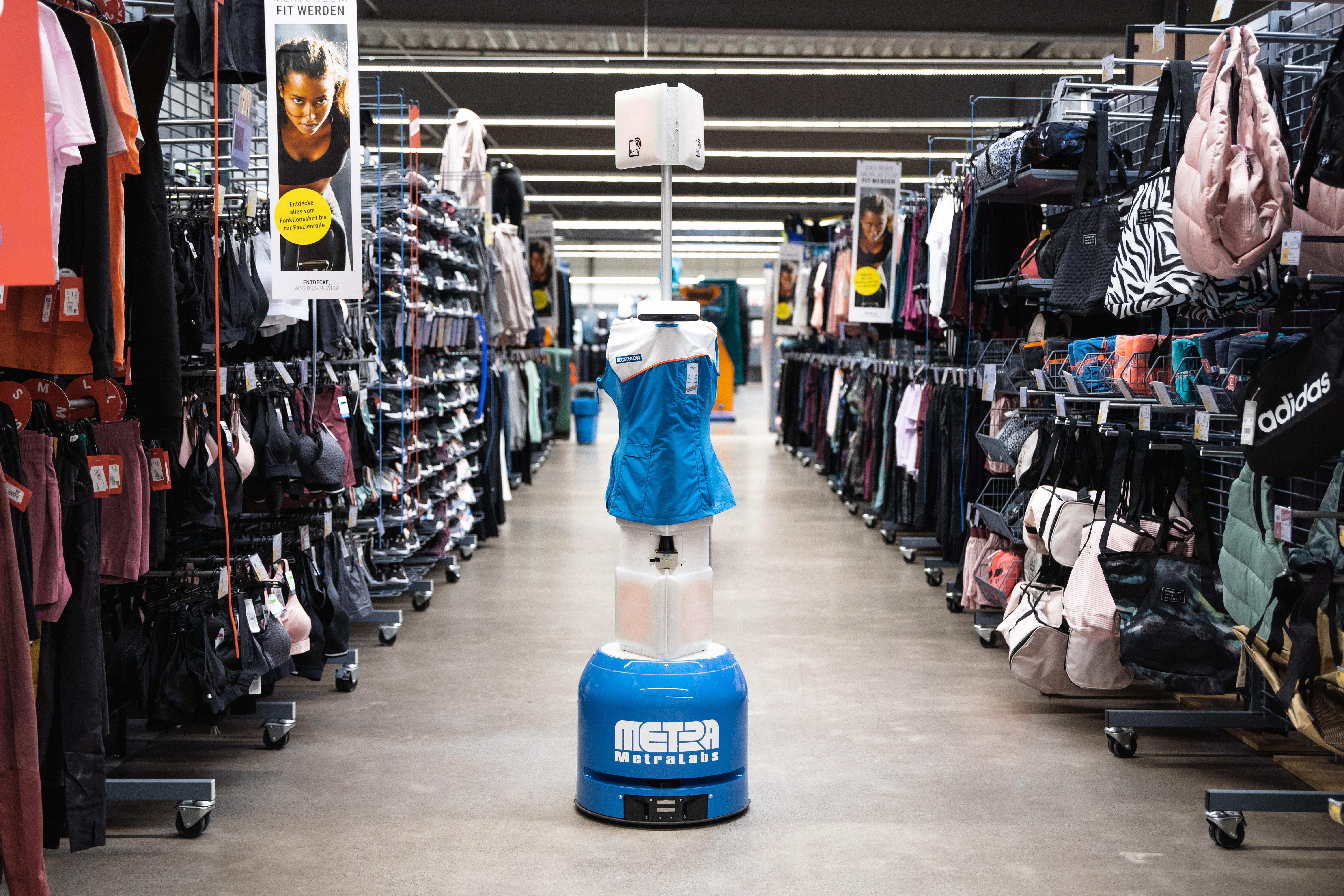
A robot helps with stocktaking, smart mirrors recommend suitable items in the fitting room and chatbots answer all our questions - the use of artificial intelligence can increase a retailer's appeal and boost sales. However, not all retailers have yet recognized the benefits of AI in retail stores. Nevertheless, the industry is waiting in the wings.
All insights at a glance
- Decathlon: Robot helps with stocktaking
- Saving time for human colleagues
- "Tory" also launched in Australia and New Zealand
- AI is picking up speed - in bricks-and-mortar retail too
- Robots are the future of retail
- Easy use of AI in Germany
- Improved shopping experience in stores
- Reasons for the snail's pace of implementation
- AI knowledge for everyone - "Knowledge4Retail" project
- Connecting the digital world with brick-and-mortar retail
- Benefits of AI
The door to the sports store opens and a robot greets us with a friendly "Hello" and the question "What are you looking for?". And then it accompanies us on our shopping trip. It suggests suitable products, guides us to the best deal or shows us on its integrated screen how a T-shirt looks on us without us having to try it on. Dreams of the future? Not for much longer!
Decathlon: Robot helps with stocktaking
Robots with learning capabilities are already helping retailers with important tasks, such as keeping the right products in stock in sufficient quantities. But how can stock be managed more efficiently? How can sales data be analyzed more quickly - combined with (seasonal) demand forecasting?
The first "Tory" started work in April 2021 at Decathlon in Stockport, UK. Since 2022, the RFID robot has also been helping with stocktaking in German Decathlon stores. The RFID robot automatically travels through the aisles of the store outside of opening hours and scans the RFID labels on the products. In Ludwigshafen, it takes around 3.5 hours to cover an area of 4,300 square meters and 93,000 products - a sporting achievement! According to press spokeswoman Nora Lühne, Decathlon already has 64 automated employees working at the beginning of 2024.
Saving time for human colleagues
"Our most important indicator for the success of the project is the availability of our products. Since the start of the test, this has been five percent higher in the Ludwigshafen store than in comparable Decathlon stores," says Sven Neuheisel, project manager for the RFID robot at Decathlon Germany. Another advantage: the teammates save time and can focus on providing advice.
"Tory" also at the start in Australia and New Zealand
The inventory robot was developed by MetraLabs, a German company that specializes in service robots for the retail sector. Tory" is already driving through stores in Australia and New Zealand. In Kmart supermarkets, it checks stock levels and reports gaps on the shelves. And perhaps the rolling helper will soon have another job: "Tory" can be equipped with a multimodal user interface with voice and touch input. And then customers can ask him where to find a particular product or department. The music of the future can already be heard.
AI is picking up speed - also in brick-and-mortar retail
In the office, smart assistants can already sort our emails according to priority, suggest answers, summarize extensive documents, answer calls or translate speech in real time. In eCommerce, AI supports visual product searches and offers personalized buying advice. There are virtual fitting rooms and communication via chatbot for FAQs. And in bricks-and-mortar retail? It is catching up: The proportion of German retail companies using AI in individual areas or across companies rose from 7.5 percent (2022) to 23.5 percent in 2023. This is the result of a study of the German Retail Association (HDE) in cooperation with Safaric Consulting and the University of Münster.
Robots are the future of retail
"We're at a stage where technology is getting better and cheaper and the case for automation in some of these areas is just becoming much more compelling," says UK McKinsey consultant Anita Balchandani (Source: World Economic Forum/Reuters). Looking at the fashion industry, McKinsey expects fashion companies to double their investment in technology from 1.6 to 1.8 percent of their turnover in 2021 to 3 to 3.5 percent in 2030.
Other examples cited by Reuters include the British online grocery pioneer Ocado, which sells its automated warehouses and lightweight robots to retailers in the United States, Europe and Asia. The US chain Sam's Club, which belongs to Walmart, has almost 600 robots cleaning the floors of its stores.
Easy use of AI in Germany
The German Federal Ministry for Economic Affairs and Climate Change sees potential applications for AI in four areas: head office, logistics and transportation, stores and customer experience. However, the current AI use cases are heavily concentrated in the "head office" area: the retail companies surveyed by HDE state that AI is used in particular for document processing in accounting (6.6%), general sales forecasts (5.6%), checking supplier data (5.1%) and for personnel requirements and workforce planning (4.6%).
In the "store" sector, too, it is still the rather simple AI applications that are used, such as camera systems for theft protection at the POS (7.1%). Artificial intelligence could not only personalize marketing or tailor product ranges to customer flows, but also adjust the price of products in real time.
Improved in-store shopping experience
Improving the shopping experience and thus increasing sales - stationary sports retailers could play a pioneering role here, for example with a robot that helps with the product search in the store and provides individual advice. Then there are smart mirrors that combine virtual reality with traditional shopping by transforming shopping into a convenient and enjoyable experience. For example, the mirror shows rain trousers to match the rain jacket or recommends the latest water-repellent running shoes. This is made possible by sensors in the changing room that use RFID technology to recognize the item being tried on.
Reasons for the snail's pace of implementation
The ideas are there, as is the technology - but there is still often a lack of implementation. 8.9% of the companies surveyed by HDE cite a lack of support from (top) management as one of the reasons for a lack of AI deployment. The desire for more concrete use cases is at the top of the list (66.7 percent), followed by lower costs for operating AI (57.8 percent) and increased benefits from AI projects.
The conclusion of the HDE study: cost- and time-intensive AI use cases are still hardly represented in retail companies, although both smaller and larger companies took part in the study. Companies may initially focus on using AI in areas where visible results can be achieved quickly in order to justify their investments. Another reason could be budget or resource constraints.
AI knowledge for everyone - "Knowledge4Retail" project
"Shopping experiences are increasingly taking place digitally - does bricks-and-mortar retail still have a future? We think so, absolutely!" says the website of "Knowledge4Retail". This consortium of 13 companies from the fields of retail, AI algorithms, platform economics and IT integration is building an AI data platform that connects the digital world with bricks-and-mortar retail - and it's all open source.
As part of the project, four prototype applications were designed and implemented based on the developed data model. These prototypes include intelligent intralogistics, strategic retail marketing to establish customer-specific stores, service robotics to support store employees and the Internet of Things connection of an intelligent refrigerator. "The motivation for the project is the fact that little data is available about the movement of products or the customer's interaction with a product in a store. However, the availability of such data would enable new services, for example the optimization of store layouts, the support of store employees and an improved shopping experience for customers," says Tim Schopf from the Technical University of Munich. He presented the project at the "International Conference on Artificial Intelligence for Industries" in California in 2022.
My coach, the artificial intelligence
Connecting the digital world with brick-and-mortar retail
Schopf concludes: "In order to close the gap between physical stores and online stores, the industry must make an effort to connect the digital world with brick-and-mortar retail. However, it is not enough to just have individual digitalization solutions; a holistic concept for the entire industry is required. To achieve this goal, an AI platform for brick-and-mortar retail is needed that enables the industry to develop data-driven applications."
How helpful are training plans from ChatGPT & Co?