Meet Taiwan's textile innovators at TAIWAN SELECT at ISPO
Details
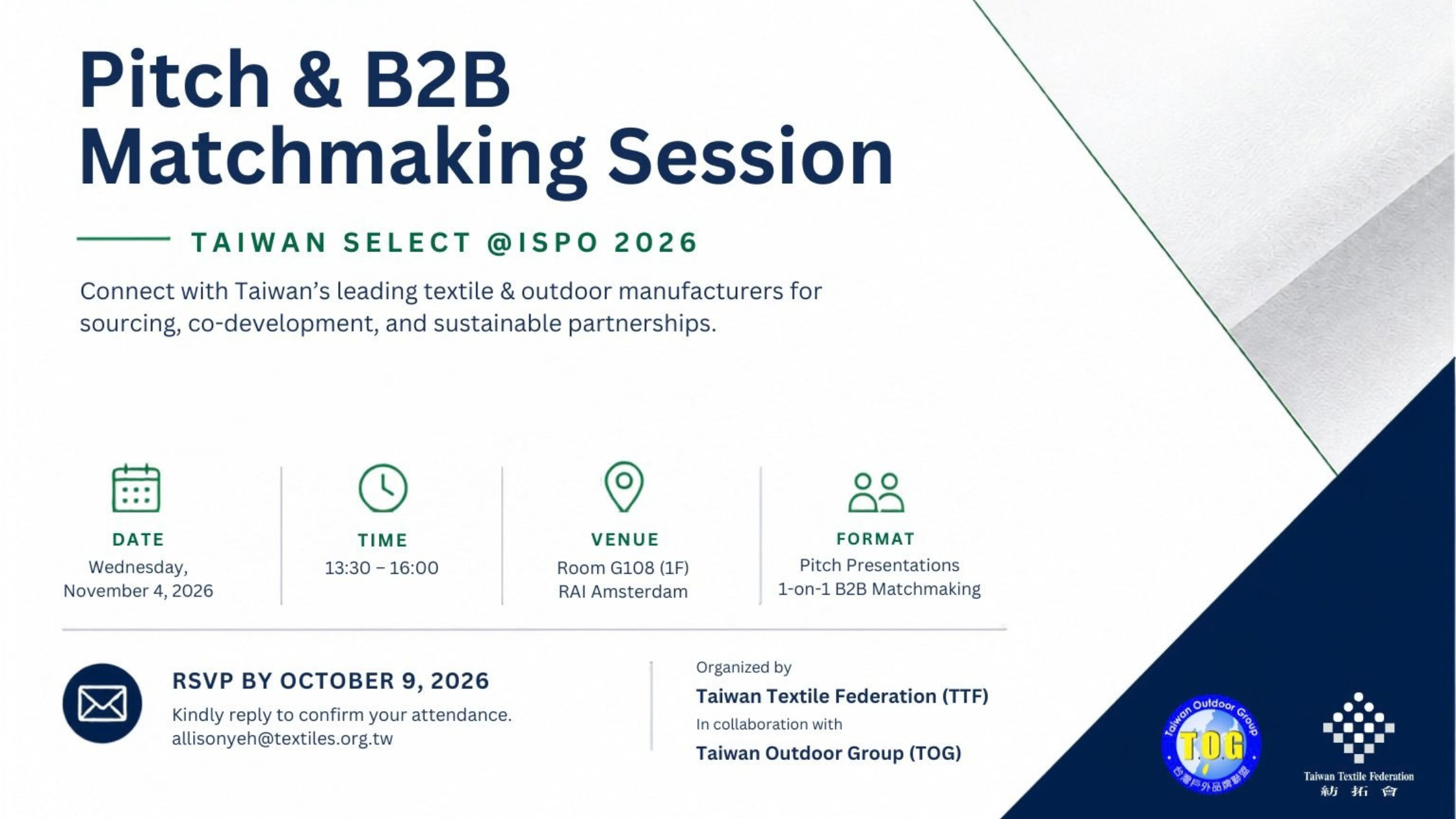
Looking for your next performance fabric, circular material or component partner? The Taiwan Textile Federation (TTF), in collaboration with the Taiwan Outdoor Group (TOG), is hosting a Pitch & B2B Matchmaking Session at ISPO 2026 in Amsterdam, bringing some of Taiwan's leading textile and outdoor manufacturers directly to European brands.
Taiwan has long been a powerhouse in technical textiles, supplying fabrics and components to many of the world's best-known sportswear and outdoor brands. This session is a chance to meet those manufacturers face to face and explore sourcing, co-development and sustainable partnerships.
Who should attend?
The session is designed for fabric and material buyers, sourcing directors, material developers, sustainability managers and product designers working across sportswear, outdoor and performance wear.
What to expect
Visitors will get direct access to verified Taiwanese performance textiles, circular materials and component innovations. The afternoon combines fast-paced pitch presentations with pre-arranged one-to-one business matchmaking, so you can move quickly from discovery to meaningful conversations with suppliers who match your needs.
Arrive early for the Welcome Reception from 13:00 to 13:30, with complimentary refreshments and the chance to network before the presentations begin.
Event details
Date: Wednesday 4 November 2026 Time: 13:30 to 16:00 (Welcome Reception from 13:00) Venue: Room G108 (1F), RAI Amsterdam Format: Pitch presentations and one-to-one B2B matchmaking
How to RSVP
Places for pre-arranged matchmaking are limited, so please RSVP by 9 October 2026 by emailing Allison at This email address is being protected from spambots. You need JavaScript enabled to view it.. You're also welcome to join on the day during the Welcome Reception.
Your Stay at ISPO 2026: Hotels, Flights and Getting to Amsterdam
Details
Amsterdam in November: crisp air, canal-side walks, and three days of the best in sports business. ISPO 2026 takes place from 3 to 5 November at the RAI Amsterdam, and whether you're joining us for the Leaders' Summit, the Exhibition, or the full three days, a little planning now will make your trip much smoother. Here's everything you need to know about getting there and finding somewhere comfortable to rest your head.
First things first: the schedule
Tuesday 3 November is dedicated to the ISPO Leaders Summit, with doors opening at 7:30am and sessions running from 8:30am to 5pm. The Exhibition then opens its doors on Wednesday 4 November (9am to 6pm) and Thursday 5 November (9am to 5pm). If you're planning to catch both the Summit and the Expo, you'll want accommodation from Monday evening at the latest.
Where to stay
Amsterdam is a popular city at any time of year, and hotels near the RAI fill up quickly during major events. Our number one tip? Book your accommodation as early as you can.
To make things easy, we've partnered with RAI Hotel Services as our official ISPO hotel partner. Booking through them means you'll get the best available rates, a wide choice of hotels right across Amsterdam, and the peace of mind that comes with a secure, trustworthy booking. You can arrange both your hotel and transport through their dedicated ISPO 2026 booking portal and their team is on hand to help with any questions at This email address is being protected from spambots. You need JavaScript enabled to view it..
Flying in? Save 10% with Air France and KLM
For everyone travelling to ISPO, attendees can get 10% off flights with Air France and KLM. The discount covers travel between 27 October and 12 November 2026, so there's plenty of flexibility if you fancy arriving early or staying on to explore the city.
Claiming your discount is simple:
Head to the Air France or KLM website, depending on your preferred currency.
When asked if you're travelling for business, select "Yes".
Enter "MICE" in the contract name field (or your company OIN or BlueBiz number, if you have one).
On the payment page, enter the discount code GME61191EU.
Click "Apply" and you're all set (subject to conditions).
Please check this before you book: the discount only applies when the base fare, excluding taxes and fees, is above a minimum value. That's €75 for domestic flights within France, €140 for flights within Europe and €170 for intercontinental flights (or the equivalent in your currency). Because taxes and fees make up a large part of many ticket prices, a lot of short-haul European fares will fall below the €140 threshold, so the code may not apply to your booking. It's worth checking the fare breakdown before you reach the payment page.
As a little extra, entering "MICE" as your contract name also gets you free standard seat selection and name changes, which is brilliant if your team's travel plans are still taking shape. The full terms and conditions are available on the Air France KLM website.
Getting to the RAI
The RAI Amsterdam is one of the best-connected venues in Europe. Whether you're arriving by plane, train, car or metro, you'll find it easy to reach. The RAI's own route planner has all the details to help you plan your journey.
See you in Amsterdam!
With your hotel booked and your flights sorted, all that's left is to get excited. If you haven't registered yet, now's the perfect time to secure your place. We can't wait to welcome you to ISPO 2026.
Slow Down, Look Closer: Inclusive Nature Exploration at ISPO Amsterdam
Details
ISPO takes place at the RAI Amsterdam from 3 to 5 November 2026, bringing the sports and outdoor industry together for three days of new products, packed diaries and back-to-back conversations. As part of this year's show programme, our partner the European Outdoor Conservation Association (EOCA) is inviting attendees to start the final day by slowing right down.
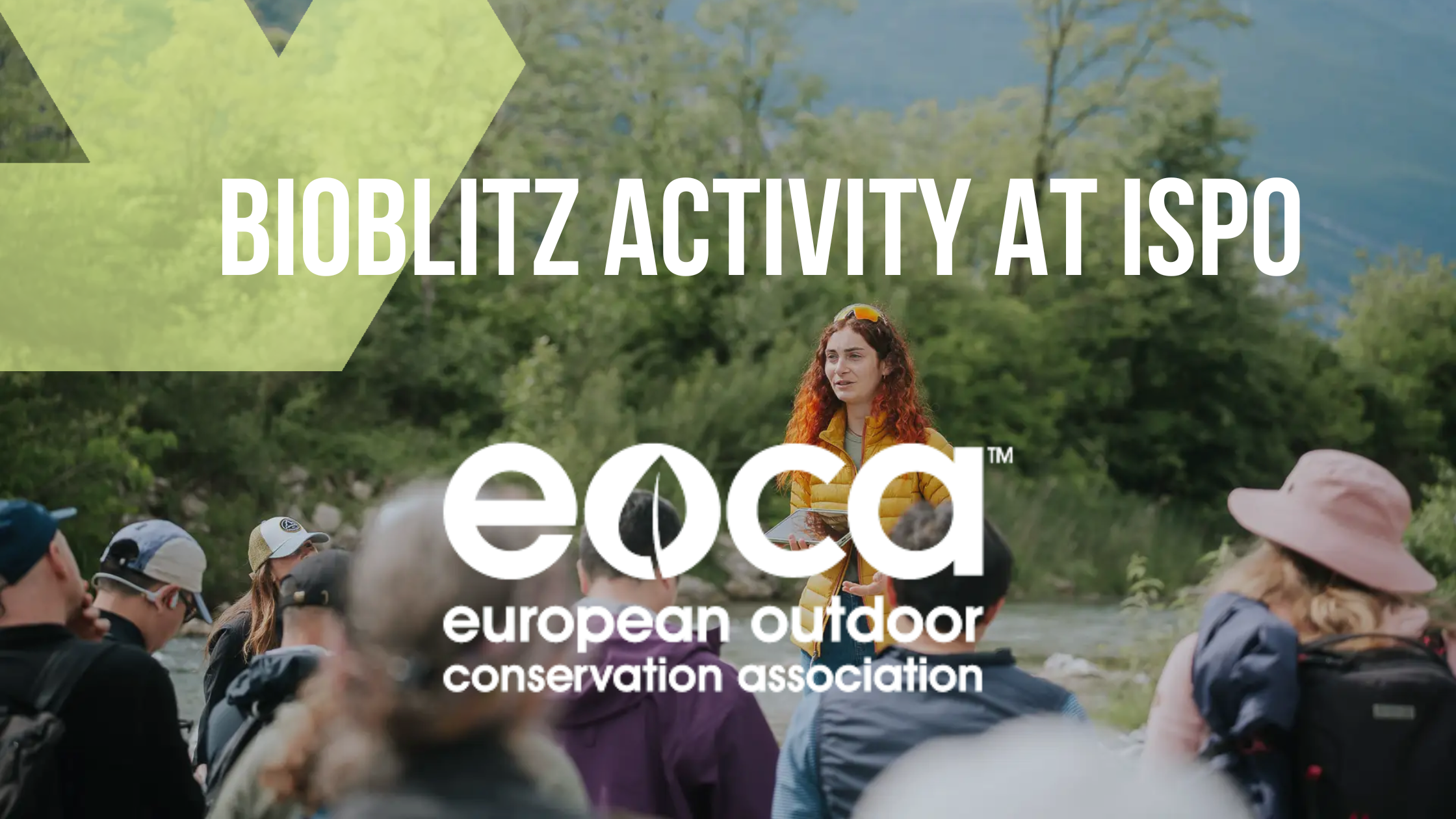
On Thursday 5 November, from 8:30am to 10am, EOCA and Adaptive As Standard will host Inclusive Nature Exploration in the Heart of Amsterdam, a guided morning that connects you with the nature around the venue and with yourself.
A Bioblitz on our doorstep
EOCA's in-house ecologist will lead a small-scale Bioblitz, a citizen-science activity that captures a snapshot of the wildlife and plant life in one place at one moment. Using the iNaturalist app, participants will record what they find together, creating real data that can support science and conservation.
Along the way, you'll look at the small details we usually rush past, learn which species make their home in urban green spaces, and explore how human activity has shaped them. It's a practical, accessible introduction to citizen science, and a reminder that nature isn't only found on distant trails. It's right here, and it needs protecting.
Returning to the body
Alongside the Bioblitz, Alice Sainsbury, Somatic Ecologist and founder of Adaptive As Standard, will guide participants through somatic ecology. Put simply, it's the idea that our bodies aren't separate from nature. They are part of it. Through movement, rest and sensory connection, Alice invites people to slow down, listen and reconnect with themselves, with each other and with the living world.
Four questions to explore
The morning is built around four themes: what lives here that we normally miss, how people have affected this ecosystem, how those impacts shape our ability to connect with nature, and how connecting with nature can help us connect with ourselves and each other.
Nature for everybody
This experience is designed around the people taking part, rather than asking them to adapt to it. The route is accessible, there are regular chances to sit and rest, and the group moves at the pace of its slowest member. There's no required fitness level or "right" way to experience nature. When you register, you'll be asked a few optional questions about anything that would help you take part comfortably. You won't be asked for a diagnosis or medical information.
Join us there
This activation is part of the official ISPO programme, so you'll need to be registered for ISPO Amsterdam to attend. If you haven't registered yet, you can do so here
Once you're registered for the show, secure your place on the session here: https://luma.com/b6q87roy Places are limited, and the exact meeting point will be shared when you sign up.
Brands interested in collaborating on the activation can contact EOCA via eocaconservation.org.
100 Miles, through the night: Raccoon Media Group completes gruelling South Downs relay for Birmingham Children’s Hospital
Details
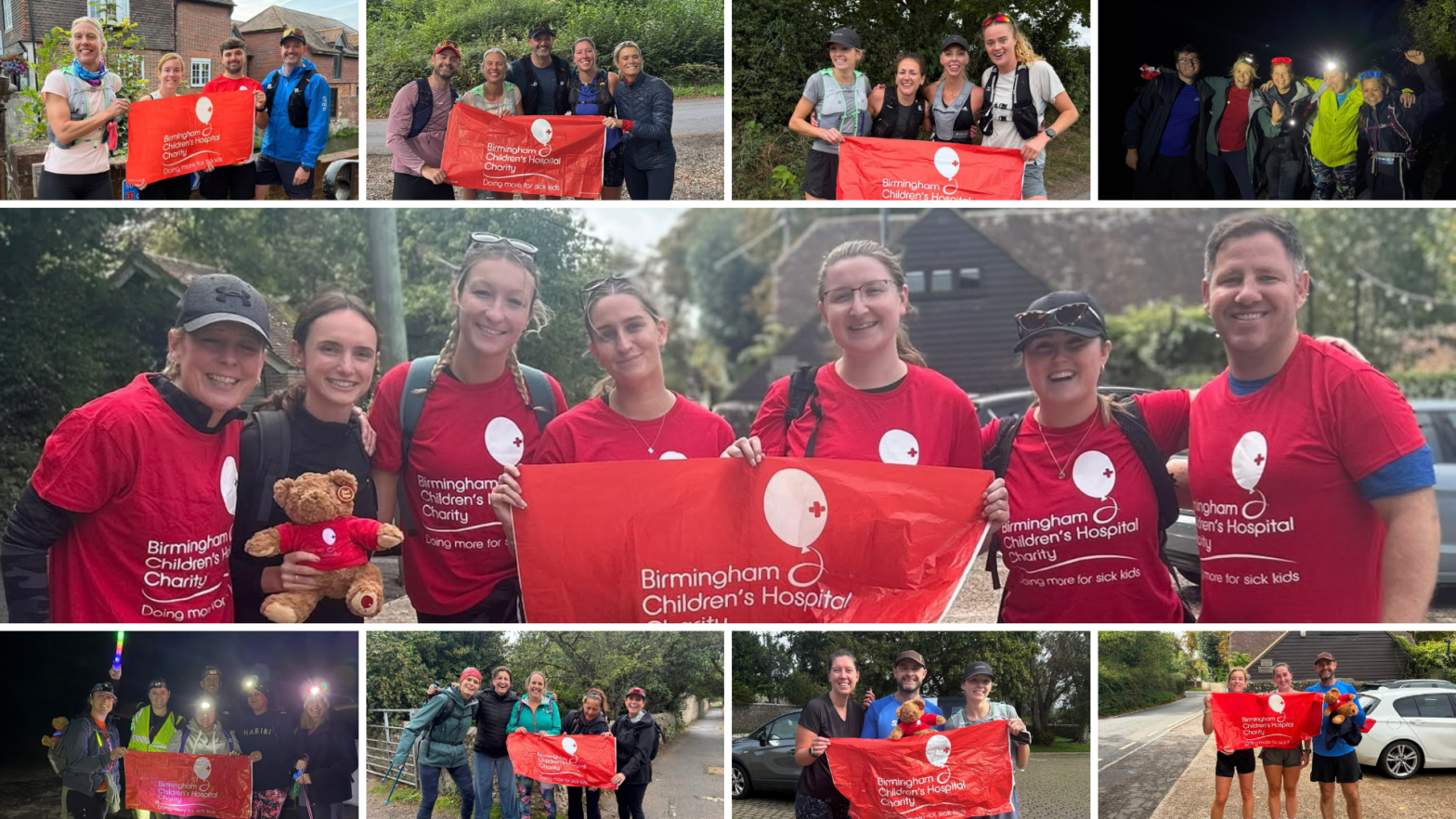
A tenacious team from Raccoon Media Group has successfully conquered a brutal 100-mile relay across the iconic South Downs Way, raising an incredible £10.8k (rising to £13.3k with Gift Aid) for Birmingham Children’s Hospital Charity.
The non-stop, 100-mile challenge started on Friday, 18th September, at Winchester City Mill and finished the next day in Eastbourne. Trekking through the night, a team of 32 Team Raccoon members walked and ran across nine different stages to complete one of England’s most famous trails. The relay was tackled in groups, with a few extra-determined team members even volunteering to complete more than one leg to ensure they got across the finish line.
Birmingham Children’s Hospital does extraordinary work caring for some of the most seriously ill children in the UK. Every pound raised by the Raccoon Media Group team goes directly towards improving the lives of young patients and supporting their families during incredibly difficult times.
The 100-mile relay challenge was made possible thanks to the generous support of several industry brands who donated essential kit and nutrition to keep the team moving. Raccoon Media Group extends its sincere thanks to Up & Running for support, Caffeine Bullet for providing energy chews, Altra for high-performance running shoes, and Beet It Sport for energy gels. Additional vital support came from Nixi Body providing leak-proof period pants, Goodr with sunglasses, Sprints for running caps, Body Glide for anti-chafing cream, and Versus Socks for performance socks.
Mike Seaman, CEO of Raccoon Media Group, commented: “Conquering 100 miles across the South Downs overnight was an extraordinary test of endurance, but our team’s collective spirit fuelled every mile. Knowing that each step raised vital funds for the life-saving work of Birmingham Children’s Hospital – a charity incredibly close to our hearts – kept us moving forward. I am immensely proud of every member of the Raccoon team for pushing their physical limits. Special recognition must go to Nathalie Davies, who masterminded the project and managed its complex logistics; we truly could not have crossed the finish line without her leadership.”
Landmark Report: Sporting Goods Industry Delivers $675 Billion in Global GDP and Supports 28 Million Jobs Worldwide
Details
First-ever global economic impact assessment ranks the sporting goods industry alongside the world’s most established global sectors supporting economic growth, innovation, jobs and healthier societies by enabling participation in sport and physical activity.
The Industry that Moves the World, the first-ever assessment of the sector's economic footprint, was released today by the World Federation of the Sporting Goods Industry (WFSGI) in collaboration with Oliver Wyman.
According to this landmark report, the sporting goods industry contributes an estimated $675 billion to global GDP each year – roughly 0.6% of world economic output and comparable to the entire annual GDP of Belgium and supports 28 million jobs globally, one in every 125 jobs on the planet.
The report provides a detailed breakdown of the industry's economic footprint across revenue, employment, tax contribution and innovation, alongside the trade, fiscal and health policy environment it operates. It also highlights how every stage of physical activity and sport, from grassroots participation and professional competition to sports tourism, depends on the products, sponsorship and innovation the industry provides.
"For decades, our industry has invested in innovation, enabled participation and performance, and supported economies, jobs and communities around the world. Yet until now, there has been no comprehensive assessment of the industry's global economic contribution,” said Emma Zwiebler, Chief Executive Officer of WFSGI. “This report changes that – showing we’re not only an economic powerhouse, but good for society, delivering a public health dividend by getting more people moving more often."
The total economic contribution of the sporting goods industry is an estimated $675 billion in GDP annually, considering the supply-chain and workforce wage-spending effects.
The sporting goods industry supports 28 million jobs in total, one in every 125 jobs on the planet.
The global sports economy is a $2.3 trillion market projected to reach $3.7 trillion by 2030. This projected growth is fuelled in part by grass-roots participation and elite-level competition worldwide, both of which are underpinned by the industry.
The industry generates an estimated $120 billion in direct tax revenue annually, rising to approximately $230 billion including supply-chain and wage-spending effects.
An innovative industry – sports-related patent filings have grown 7.6% annually over the past decade – more than 70% faster than patenting overall.
Sporting goods companies contributed an estimated $5 billion in cash sponsorship in 2024, in addition to product and value-in-kind support and remain the largest single source of athlete sponsorship of any industry.
Key Economic Priorities Outlined
The report states that aligning the following three priorities is one of the most cost-effective growth and health interventions available today:
Trade frameworks that support resilient global value chains and predictable market access.
Fiscal and regulatory treatment that recognizes the relationship between affordability and participation.
Public-private cooperation that connects industry capabilities with national health, industrial and sporting objectives.
Sporting goods face an average applied tariff of 14.1% nearly three times the rate applied across all traded goods. The report recognises the penalty is rooted in the industry’s own sophistication – the technical, multi-country production that makes sporting goods effective for health and performance is the same characteristic that exposes it to repeated tariff charges as materials, components and finished products cross borders.
What makes the products good for people makes them expensive to trade and in turn, discretionary items in many households. “At a time when physical inactivity is rising globally, we should be looking at how policy can make sport more accessible for people of all ages and backgrounds," said Zwiebler. “Governments, industry and society all have a role to play in aligning policy to keep barriers to participation as low as possible."
Not Simply Another Player
WFSGI Co-Chairs Jorge Casimiro and Dave Wheeler see this report as both a benchmark and a platform for the sporting goods industry:
Jorge Casimiro, Co-Chair of WFSGI and Chief Government & Public Affairs and Public Policy Officer at Nike: “This report provides compelling evidence that the sporting goods industry is not simply another player in the global economy, but one of the world's great economic and social success stories. What truly distinguishes our industry is its dual role as both an economic powerhouse and a crucial driver behind sport and participation."
Dave Wheeler, Co-Chair of WFSGI and Chief Operating Officer at New Balance: "Every investment, every innovation and every product is intrinsically linked to a broader public good. When more people participate in sport and movement, society benefits through improved physical and mental health, enhanced productivity and stronger communities."
Tony Simpson, Partner, Global Sport Industry Lead, Oliver Wyman:“For the first time, we can put a comprehensive economic value on the sporting goods industry and demonstrate the scale of its contribution to the global economy. What stands out from the analysis is not just the industry’s economic footprint, but the relationship between innovation, participation, and public health. The industry’s economic success and participation are closely connected. Greater participation supports industry growth and continued investment in innovation, while also contributing to healthier populations and stronger economies.”