

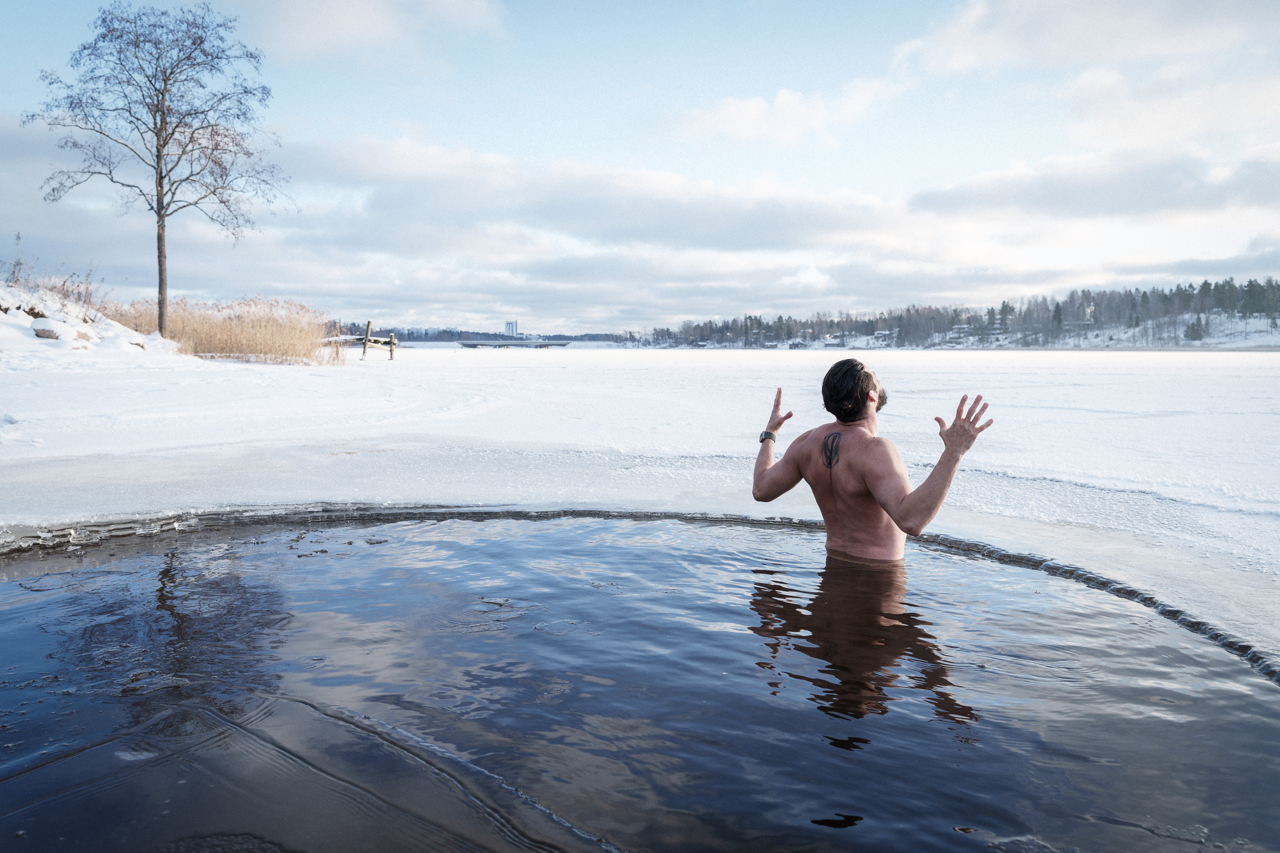
Ice bathing sounds like frozen lakes and crystal-clear mountain streams, but there is another way: laboratory instead of nature, barrel instead of pond, medical monitoring instead of inner contemplation. In their IceBAT study, researchers from the Technical University of Munich investigated the influence of ice baths on the metabolism and cardiovascular system depending on the time of day. In the middle of it all: Christoph Beaufils from ISPO.com
An ice bath is definitely not for hot showers. Immersing yourself scantily clad in water at a temperature just above freezing takes a lot of effort - and staying in it for several minutes is even harder. Why would anyone voluntarily expose themselves to such a cold shock?
Overview of the Insights:
- Fueled by the Iceman: the hype about ice bathing
- IceBAT study: Does ice bathing activate brown adipose tissue?
- Procedure: What glucose and lactate values reveal
- Fight or Flight: Conflict in the ice buoy
- Results: Activation yes, but...
- Why ice bathing can also be a matter of the mind
- From body weight to cancer research
Fueled by the Iceman: the hype about ice bathing
Diehards have long sworn by the positive effects of ice-cold hardening. In times of coronavirus, when health was an omnipresent topic anyway, the trend has picked up speed once again - fueled by 'Iceman' Wim Hof, among others. The Dutch extreme athlete and multiple world record holder for enduring extreme cold has built up a huge following through his YouTube videos. His fans follow the Wim Hof method, a combination of breathing techniques, cold baths and meditation, to specifically strengthen their immune system.
IceBAT study: Does ice bathing activate brown adipose tissue?
"However, the study situation in the field of ice baths is still very vague," says ice bath expert Maximilian Bauer. The IceBAT study, which he is leading together with Chaima Ben Brahim, should now provide new insights. The focus of interest is on brown adipose tissue.
The brown adipose tissue (BAT) that gives the project its name is located in the neck and collarbone region in humans. Unlike white adipose tissue, which stores energy, it is particularly rich in mitochondria. These organelles, which some people may remember from biology lessons as the "power plants of the cells", play an important role in maintaining body temperature.
"There are two stimulators for the activation of brown adipose tissue, namely exercise and cold," explains Bauer. "The ExBAT study had already been launched in the sports biology department at the Technical University of Munich to investigate the effects of physical exercise. So it made sense to start another project on cold treatment."
Procedure: What glucose and lactate values reveal
After a one-year preparation phase and numerous test runs, the study can finally begin. The test subjects - six women, six men, healthy, aged between 18 and 40 and within defined BMI limits - enter the ice buoy twice for five minutes. Once between eight and ten o'clock in the morning, then, at intervals of at least one week, once again between 5 and 7 pm. A measurement of resting energy expenditure (REE) provides information about metabolic processes in the body. Heart rate and surface temperature are also recorded. However, the primary target variables of the IceBAT study are glucose and lactate in the blood.
"The brown adipose tissue absorbs these substances from the bloodstream in order to use them as energy resources," explains Bauer. "This is how it generates heat." Falling glucose and lactate levels would therefore indicate BAT activation by the ice bath.
One of the test subjects is Christoph Beaufils, Brand Strategist at ISPO.com. His spontaneous reaction to the ice shock: "It's cold. And a little painful." However, the right breathing technique helps to withstand the cold.
Not in the mood for ice swimming? How about a run?
"Fight or Flight": Conflict in the ice buoy
The research team teaches the study participants in advance what is important when bathing in the ice buoy. "When our body gets into an extreme situation, it switches into fight-or-flight mode," says Bauer. "Heart and breathing rates shoot up. Our body does everything it can to get back into balance." After about a minute, the acceptance phase begins. During this time, the body calms down and the stay in the ice bath actually feels relatively pleasant. A calm breathing technique can help you gain control over yourself and quickly overcome the fight-or-flight phase.
Results: Activation yes, but...
As a result, the test subjects do not make a hasty escape, but leave the ice buoy as planned after the allotted time. The first test results have now been received. Have the research team's assumptions been confirmed by the IceBAT study? "We analyzed the entire fat metabolism," says Bauer. "By measuring the resting energy consumption, we recognize a change in metabolism due to the cold therapy." However, the activation of brown adipose tissue is not the same for all test subjects. Based on the blood values, the group can be divided into three categories: Non-responders, responders and super-responders.
"In the non-responders, the glucose and lactate levels do not fall. This means that the brown adipose tissue does not manage to remove the substances from the blood," explains Bauer. "Instead, people start shivering in the ice bath. The muscles work and the lactate level increases." In view of the results, the trembling can therefore be interpreted as an indication that the brown adipose tissue is not activated.
The situation is slightly different for responders. Their lactate value drops in the ice bath and rises again as soon as they leave the water. Only the super-responders do not tremble and show decreasing lactate values even five minutes after the cold application.
With regard to the time of day, the evening seems to be more suitable for an ice bath. This is suggested by the images from the thermal imaging camera. Particularly in the late hours, they show the hoped-for white spots in the BAT region on the neck and collarbone, which mean a particularly large heat development - in this case a temperature difference of three to four degrees Celsius compared to other areas of the body. And: gender could also be a factor in activation. The non-responders are primarily women, while the two super-responders are men.
Why ice bathing can also be a matter of the mind
Bauer is convinced that activation of brown adipose tissue is also possible in non-responders. "A person who shows no activation at a water temperature of eight degrees Celsius could well show a reaction at 14 degrees Celsius."
Meanwhile, the study even takes a psychological direction. After all, a routine of ice bathing could pay off for those interested. "We see that people with ice bath experience are more likely to be responders. They find it easier to leave fight-or-flight mode and accept the extreme situation." If non-responders were able to gain control of their bodies more quickly in the cold, BAT activation could also be possible for them.
Mental power: How athletes achieve top performance
From body weight to cancer research
But why is this desirable at all? "When the sympathetic nervous system in brown adipose tissue is activated by cold, energy consumption increases and the body tries to maintain body temperature by mobilizing fat stores," says Bauer. "This can help protect against obesity." BAT is also interesting for cancer research. The tissue filters certain substances from the blood that are not available to tumors for growth. However, the results of cancer research have so far been based exclusively on animal experiments and should therefore be treated with caution. However, Bauer believes that the IceBAT project could provide new insights.
For him personally, ice baths have another positive effect. "It's my meditation. I could never really switch my mind off, especially during exam periods, but ice baths always worked really well."
Whether you are hoping for health benefits from the ice-cold refreshment or simply deep relaxation: if you want to give it a try, you should definitely take a few tips to heart. And it doesn't matter whether you jump into an idyllic lake in the Alps or a barrel from the DIY store.
Mental training: how simple techniques improve performance